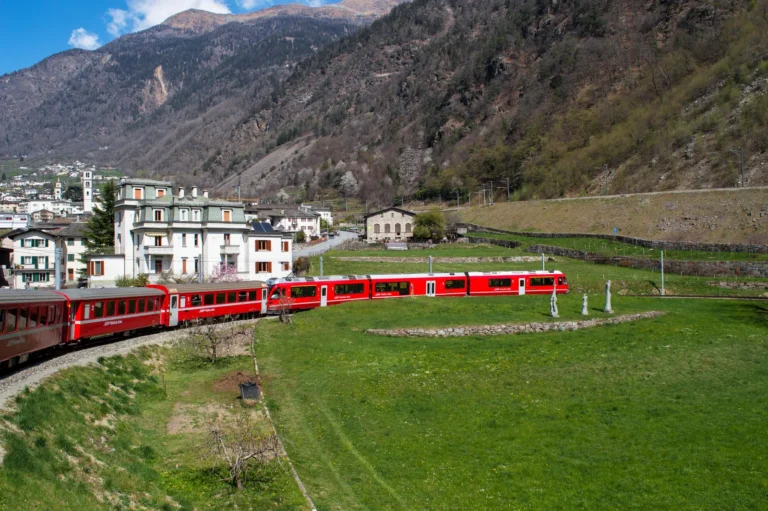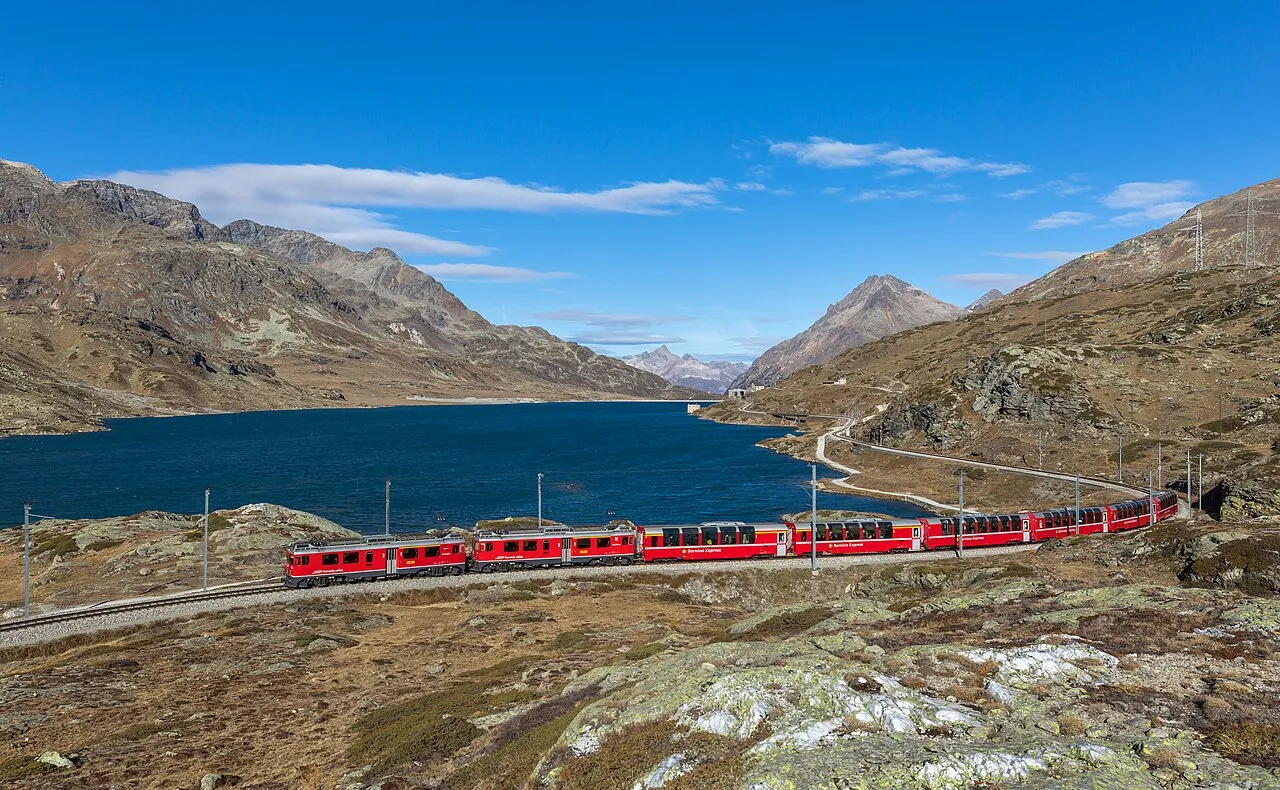
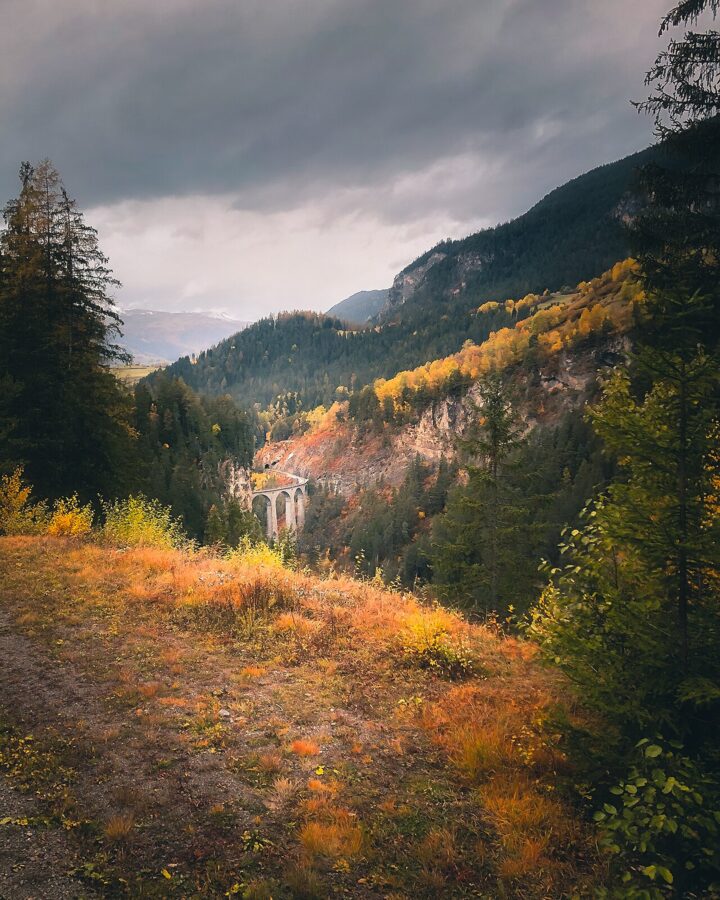
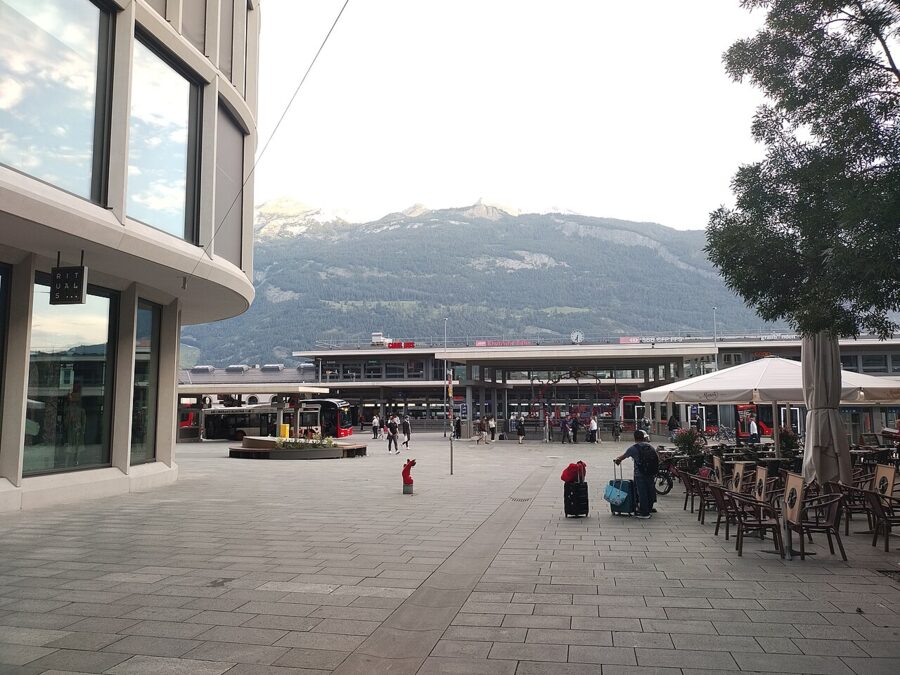
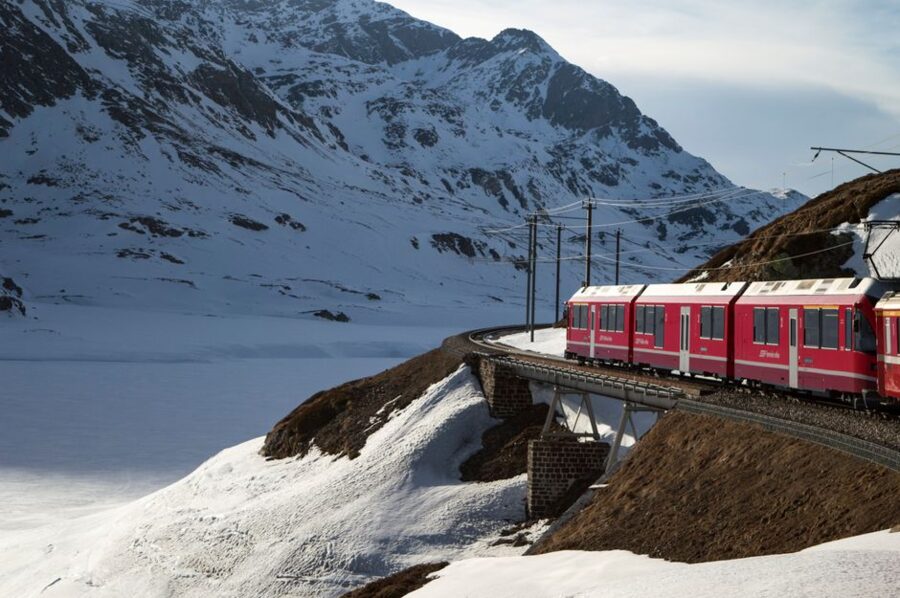
The 8:17 a.m. Bernina Express leaves Chur with its glass roofline catching the morning, and four and a half hours later it rolls across the square in front of Tirano’s pilgrimage church and stops in Italy. In between it crosses the Landwasser Viaduct a few minutes before Filisur, corkscrews through the spiral tunnels above Bergün, runs along Lago Bianco at 7,392 feet (2,253 m) and pauses for nine minutes at Alp Grüm, where the Palü Glacier hangs over the platform. Then it drops toward Italy on grades of 7 percent with no cog to hold it.
Every one of those moments comes with a choice made weeks earlier. Chur or St. Moritz, the panoramic train or the ordinary red train on the same track, a CHF 44 (about US$53) seat reservation or a CHF 5 (about US$6) one, summer green or deep snow, back the same afternoon or on by bus to Lugano. Get them right and the day is one of the best you will spend on a train anywhere.
Rhaetian Railway (RhB), the meter-gauge railway of the Swiss canton of Graubünden, runs both kinds of train, and its 2027 timetable has been open for seat reservations since the fall. Summer weekends fill first.
Stops in this article10
- 01Two old railways, one UNESCO listing
- 02Bernina Express or the regional train
- 03Tickets, the reservation and what they cost
- 04The 2027 timetable
- 05Which side to sit on
- 06What you see, in order
- 07Summer, winter and the busy months
- 08The Bernina Express Bus to Lugano
- 09Making a day or a night of it
- 10On board, and what to bring
Two old railways, one UNESCO listing
The Bernina Express is not a line of its own. It is a named train that runs over two separate railways, and UNESCO listed both together in July 2008 as the Rhaetian Railway in the Albula / Bernina Landscapes, a site shared between Switzerland and Italy.
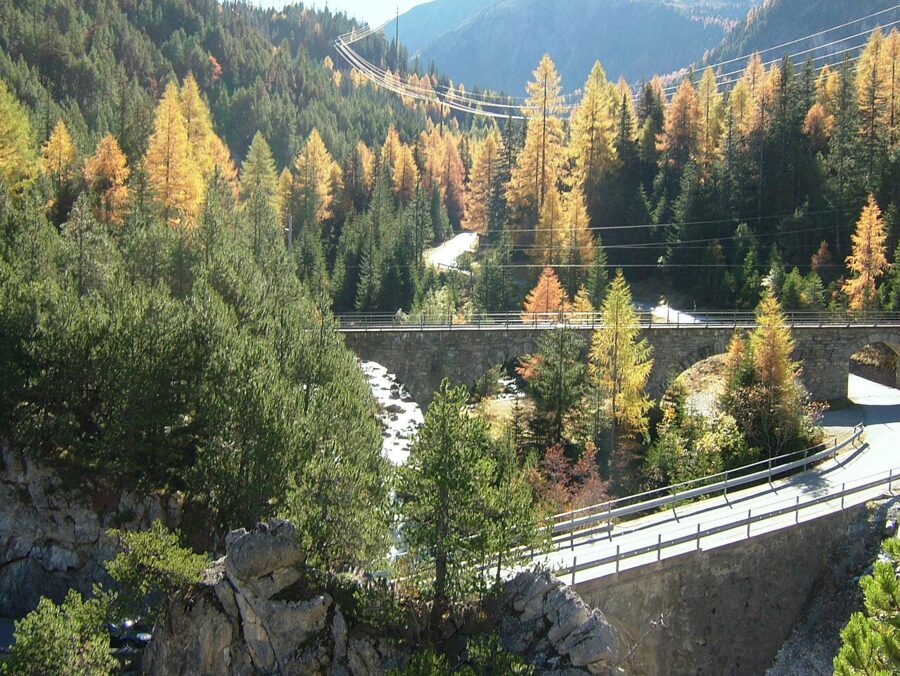
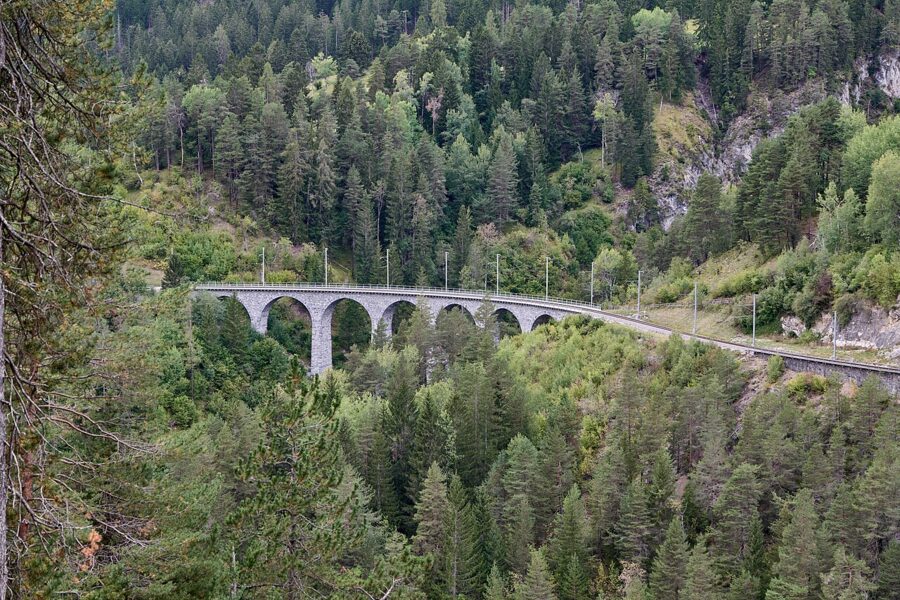
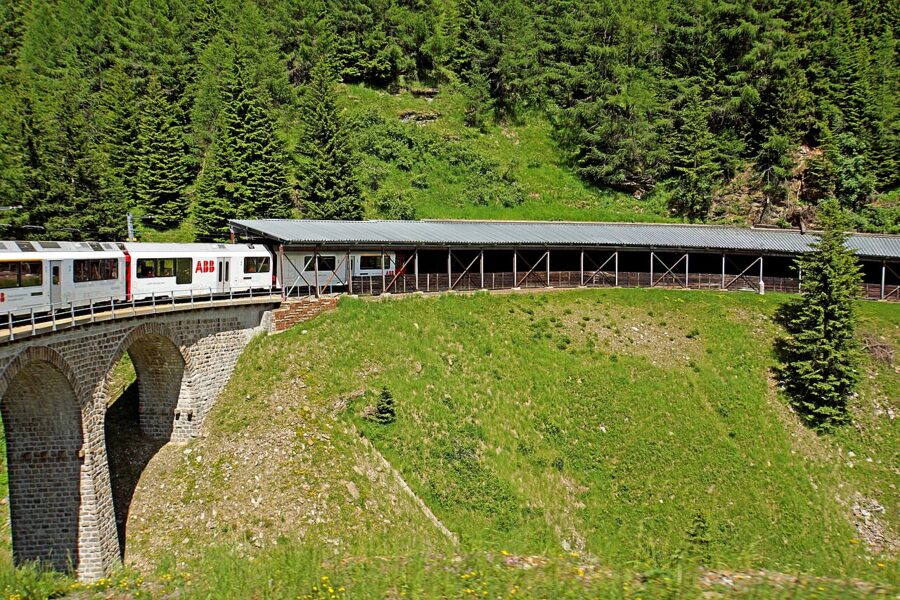
The first half is the Albula line, opened in 1904 and 42 miles (67 km) long, with 42 tunnels and covered galleries and 144 viaducts and bridges. Its builders wanted a line that would sell itself to tourists, so it runs through the valleys in deliberately spectacular fashion: between Bergün and Preda the track has to gain about 1,300 feet (400 m) in roughly 3 miles (5 km) of straight-line distance, so it loops back on itself through spiral tunnels and over stone viaducts. At the top it dives into the Albula Tunnel, 3.6 miles (5,865 m) long. A new parallel bore opened to traffic in June 2024, and the trains now use that.
The second half is the Bernina line from St. Moritz to Tirano, 38 miles (61 km), finished in July 1910 by a private company that wanted access to hydroelectric plants on the south side of the pass and to the tourist trade on the north side. It lived on the edge of bankruptcy, and Rhaetian Railway took it over in 1943. It is the highest railway crossing of the Alps and one of the steepest railways in the world that runs on plain adhesion, with grades of up to 7 percent and no rack.
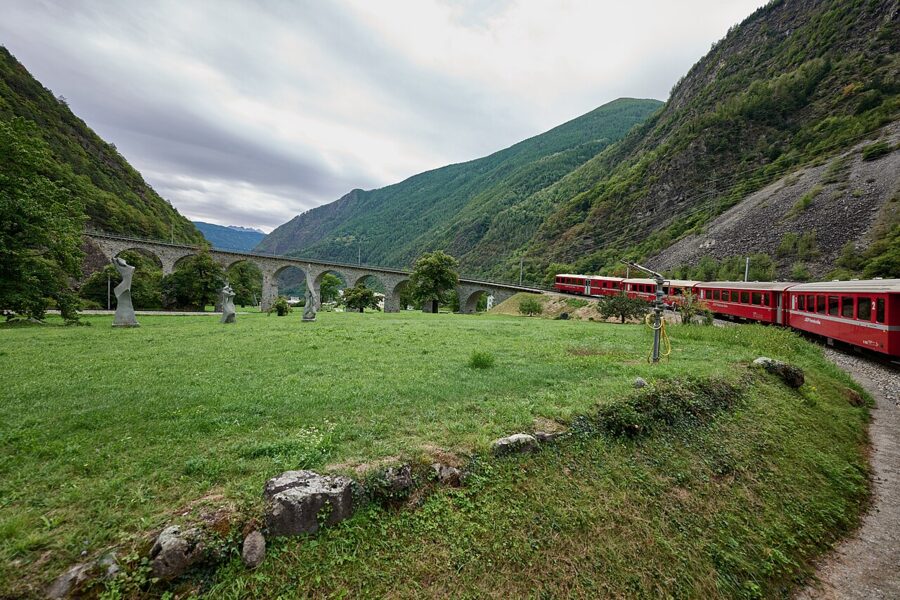
RhB counts 196 bridges and 55 tunnels on the full Bernina Express route. You will not notice most of them, because the line was built to fit the ground rather than fight it. The three you will notice are the Landwasser Viaduct, the descent below Alp Grüm and the spiral at Brusio.
Bernina Express or the regional train
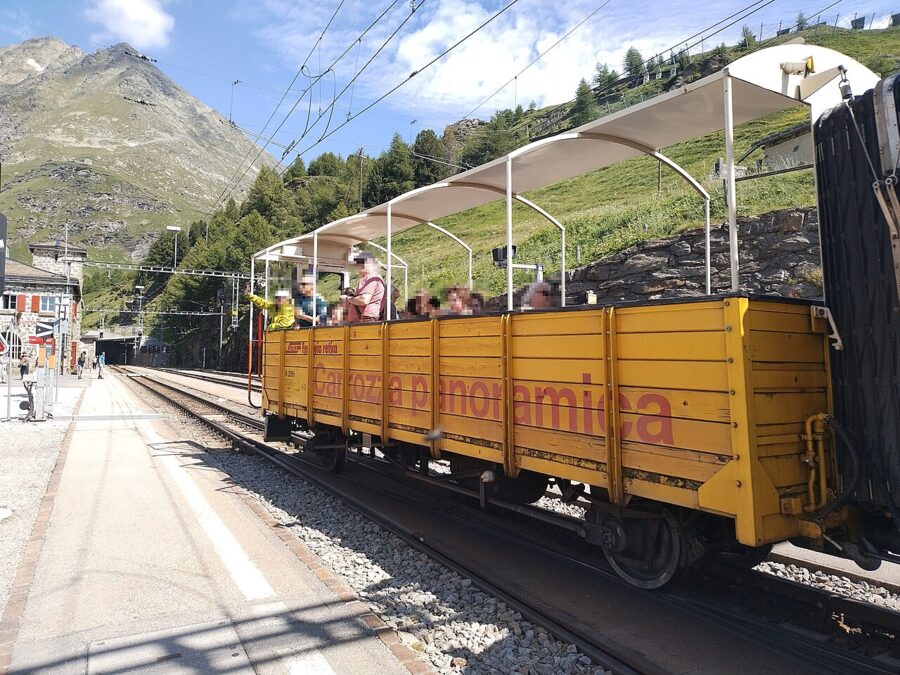
Two very different trains run on the same rails, and ticket sellers mix them up. The Bernina Express runs a few times a day in panoramic cars with windows that curve up into the roof, a compulsory paid seat reservation, free Wi-Fi, a trolley with drinks and snacks, and the InfoT(r)ainment, a free audio guide and live map on your own phone. The RhB regional trains run every hour between St. Moritz and Tirano in ordinary coaches whose windows open, with an optional seat reservation for CHF 5 on that stretch only, except in April 2027, when RhB cannot take regional-train reservations.
RhB’s own guide to telling the two apart warns that third-party sellers, especially in translation, call the regional train the Bernina Express. “Bernina red train” or “Trenino Rosso” on a tour or ticket almost always means the regional train. On the platform, the Bernina Express is the one with the white “Bernina Express” lettering and glass to the roof.
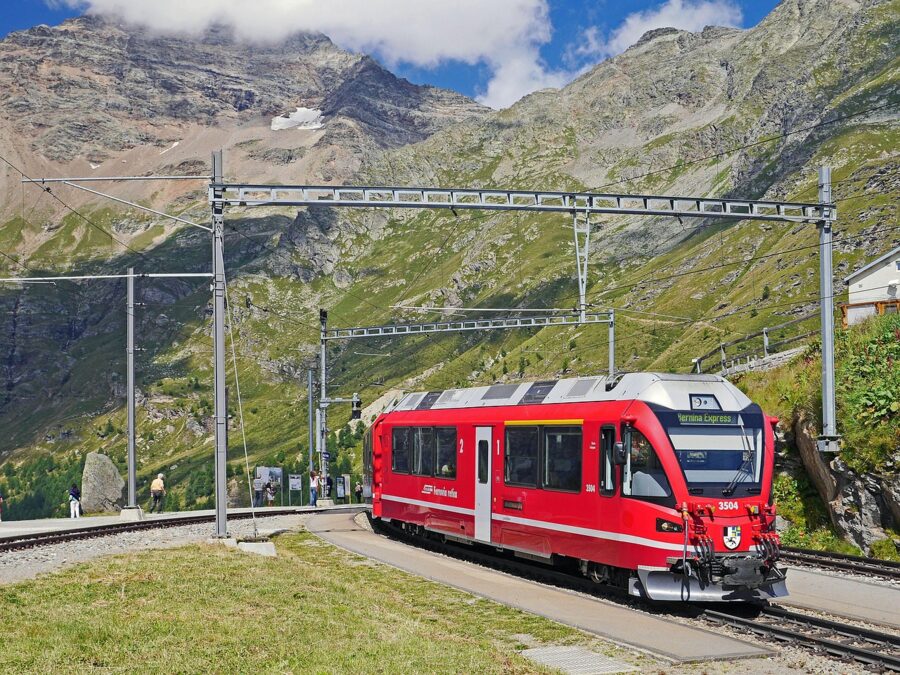
Which should you take? For the full run from Chur, I would book the Bernina Express. It saves two changes, the panoramic windows earn their money on the Albula loops and at Lago Bianco, and the nine-minute stop at Alp Grüm is built in. For St. Moritz to Tirano, the regional train is the better deal for anyone who wants to get off: hop off at Ospizio Bernina or Alp Grüm, walk, and catch the next one an hour later.
You can also do the whole Chur to Tirano trip without the Bernina Express. On a summer 2027 weekday, the 8:58 a.m. InterRegio from Chur reaches Samedan at 10:45 a.m., a short connection takes you to Pontresina at 10:55 a.m., and the 11:04 a.m. RegioExpress gets to Tirano at 1:00 p.m. That is the same four hours over the same viaducts, with two changes and windows that open, for the plain fare.
Tickets, the reservation and what they cost
A Bernina Express seat costs two things: a normal ticket for the route, and a compulsory seat reservation on top. Both are sold together in RhB’s online shop, and you need both in hand when you board. RhB publishes the fares and reservation prices on its Bernina Express page; these are per adult, one way, as of 2026.
| Route | 2nd class | 1st class | Reservation (per person) |
|---|---|---|---|
| Chur to Tirano | CHF 69 (about US$83) | CHF 118 (about US$142) | CHF 40 low season, CHF 44 peak (about US$48 or US$53) |
| Chur to Poschiavo | CHF 61 (about US$73) | CHF 104 (about US$125) | As Chur to Tirano |
| St. Moritz to Tirano | CHF 35 (about US$42) | CHF 60 (about US$72) | CHF 32 all year (about US$38) |
| St. Moritz to Poschiavo | CHF 26.20 (about US$31) | CHF 44.60 (about US$53) | CHF 32 all year |
Returns are double the single fare. The reservation is priced by train, not by distance, so a seat from Chur to Poschiavo costs the same supplement as the full run. On the Chur trains, low season runs to April 23, 2027 and peak season from April 24 to October 3, 2027, as of 2026.
Children under 6 ride free. From 6 until the day before their 16th birthday they pay half the fare, but every child pays the full reservation. Groups of ten or more get 30 percent off the fare and must book through RhB’s Railservice rather than the online shop, which cancels group bookings split into smaller ones.
Rail passes
The Swiss Travel Pass covers the fare on the Bernina Express, and so do the GA travelcard and the Eurail and Interrail passes; the Half Fare Card halves it. None of them covers the reservation, which every pass holder pays in full. So with a pass, you book “reservation only” for CHF 32 to CHF 44, and the Swiss Travel Pass terms list the Bernina Express among the trains that need it.
With a Eurail pass or an Interrail pass, choose the reservation-only option in RhB’s shop. If the pass is already paid for, the full run from Chur in the panoramic cars costs you just the CHF 40 or CHF 44 reservation, the cheapest way into those seats.
When to book
Reservations open for the whole timetable year at once: RhB activates the trains in its online shop between mid and late October for the timetable that starts in mid-December. Tickets themselves can generally be bought six months before travel. For a summer weekend, book the reservation the day you know your date; the fare can wait.
RhB’s own planning advice for the Bernina line says the trains are busiest on weekends and public holidays, quieter Monday to Thursday, and that from Friday to Sunday northbound mornings and southbound afternoons fill first. The SBB app shows when a train is expected to be busy.
Last-minute, winter deals and Pullman Class
Three offers are worth knowing. The Bernina Express Last-Minute fare is a second-class return with both reservations included, sold online only, six days or fewer before travel: CHF 107 (about US$128) for St. Moritz to Tirano and back, CHF 125 (about US$150) from Chur, or CHF 87 and CHF 105 with a Half Fare Card, as of 2026. It is good only on the booked trains, with no refunds, and in summer 2026 it was not sold on some trains.
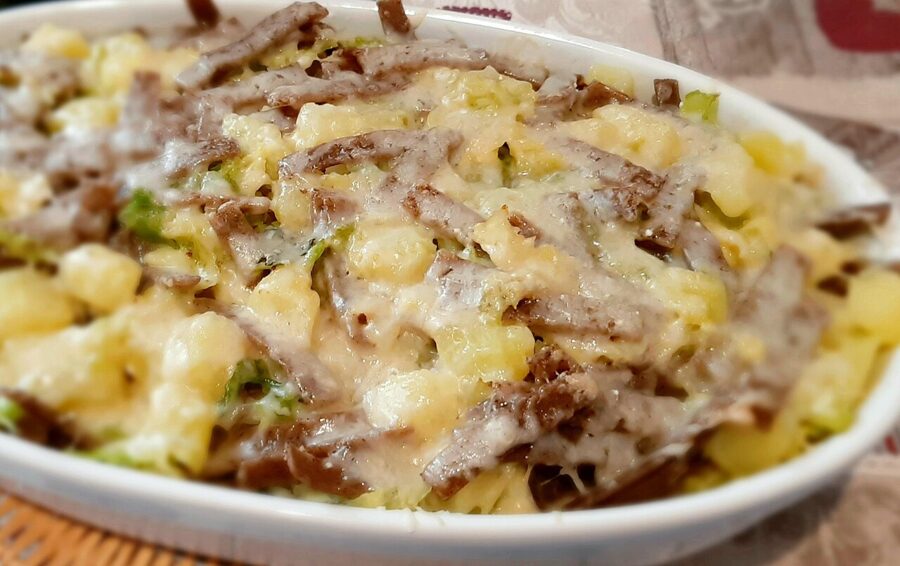
The winter Bernina Express special offer is CHF 249 (about US$299) for two people: a second-class return from Chur to Poschiavo, Le Prese or Tirano, both reservations, and a lunch of salad and pizzoccheri, the Val Poschiavo’s own pasta dish, at a partner restaurant. It can be booked from November 1, 2026 to January 31, 2027.
At the top end, Bernina Express Pullman Class is a 1930s-style saloon car with 32 seats that leaves St. Moritz at 9:17 a.m. and Tirano at 4:06 p.m. The round trip with a three-course lunch and wine at the La Gatta winery near Tirano is CHF 625 (about US$749); the round trip without lunch is CHF 565, and Swiss Travel Pass holders pay a lower fixed price. It runs from April 24 to October 3, 2027, bookings open February 1, 2027, and a booking cannot be canceled, though RhB refunds in some cases.
The 2027 timetable
The Bernina Express runs every day of the year, but how many trains depends on the season. These times come from the 2027 timetable as published in November 2026, for a midsummer weekday (June 15) and a winter weekday (January 20); summer service starts in late April, and in late April and early May the afternoon train from Chur leaves at 1:28 p.m. rather than 1:35 p.m.
| Train | Summer 2027 | Winter 2027 |
|---|---|---|
| Chur to Tirano | 8:17 a.m. to 12:50 p.m.; 1:35 p.m. to 6:00 p.m. | 8:17 a.m. to 12:50 p.m. |
| Tirano to Chur | 8:06 a.m. to 12:31 p.m.; 2:24 p.m. to 6:31 p.m. | 2:24 p.m. to 6:31 p.m. |
| St. Moritz to Tirano | 9:17 a.m. to 11:32 a.m.; 1:17 p.m. to 3:31 p.m.; 4:14 p.m. to 6:50 p.m. | 3:30 p.m. to 6:00 p.m. |
| Tirano to St. Moritz | 10:06 a.m. to 12:35 p.m.; 1:17 p.m. to 3:45 p.m.; 4:06 p.m. to 6:25 p.m. | 10:06 a.m. to 12:35 p.m. |
The trains from Chur do not call at St. Moritz: they leave the Albula line at Samedan and join the Bernina line at Pontresina. If you are staying in St. Moritz, take the St. Moritz trains, or ride a regional train to Pontresina and pick up the Chur train there at 10:25 a.m. RhB puts the Chur to Tirano run at about four hours and St. Moritz to Tirano at about 2 hours 15 minutes.
Which side to sit on
Heading south to Tirano, sit on the right. Heading north, sit on the left. The big panoramic windows show both sides well, but the right side southbound gets the water and the ice up close.
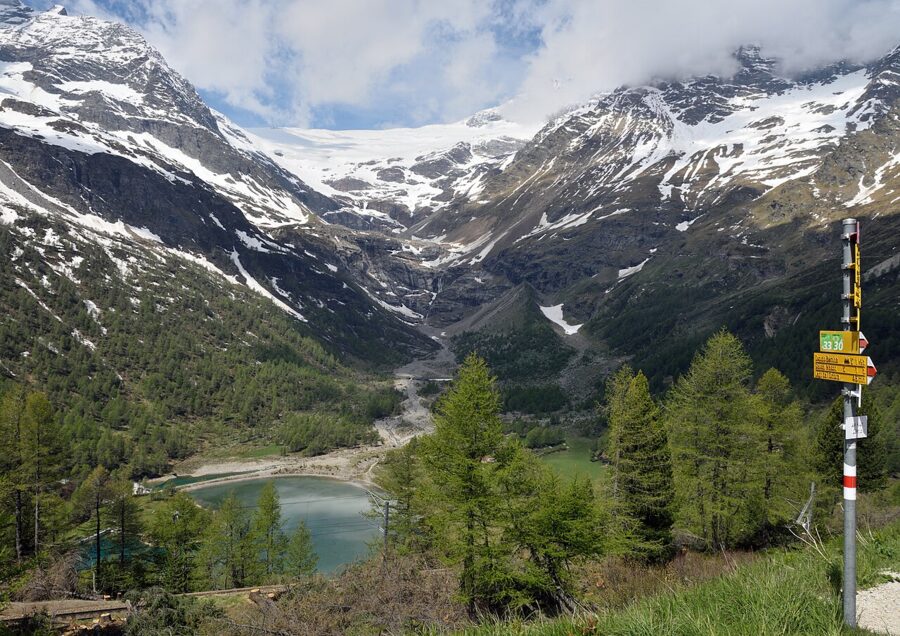
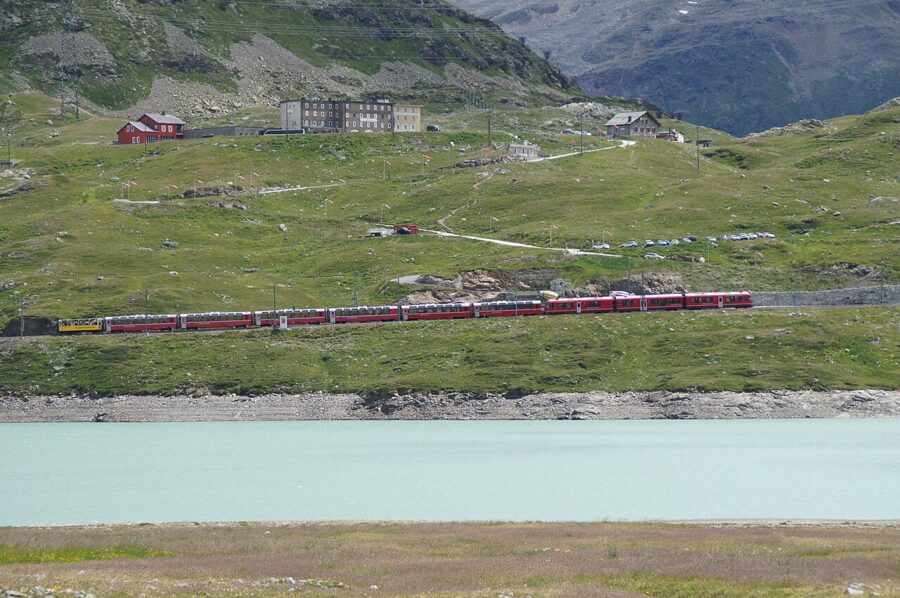
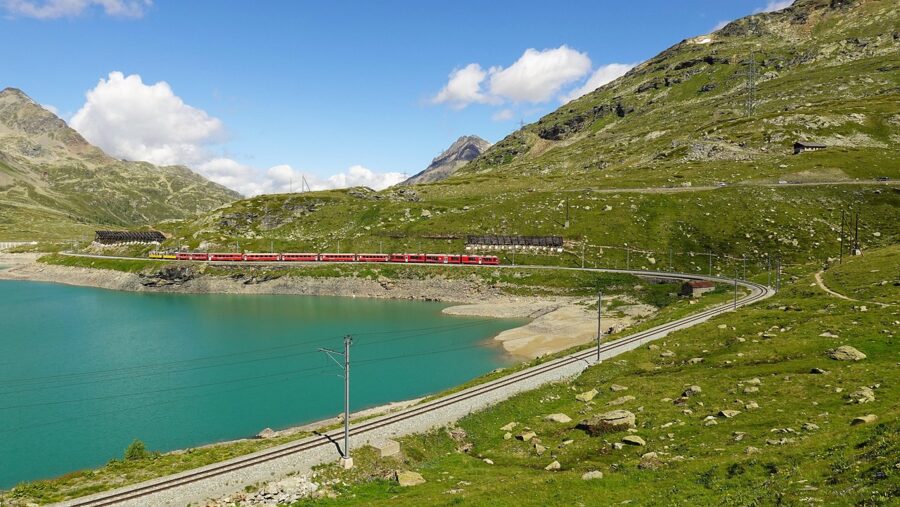
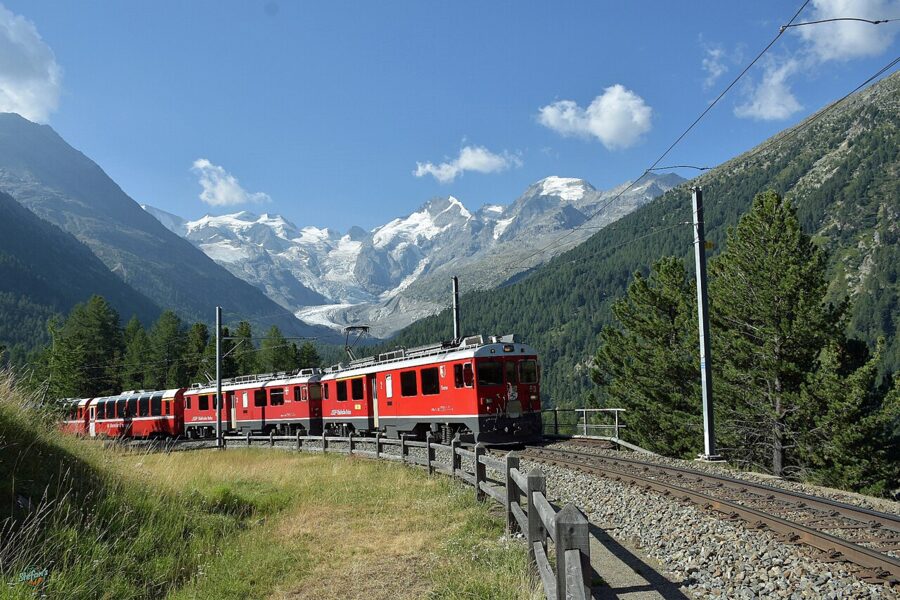
The clearest case is Lago Bianco. The railway runs along the eastern shore of the lake, with Ospizio Bernina station about halfway, so heading south the lake fills the right-hand windows. Climbing from Pontresina, the Morteratsch valley and the glaciers of the Bernina range open on the right as well, and at Alp Grüm the Palü Glacier is on the same side.
Two places are fair to both sides. On the curved Landwasser Viaduct and in the Brusio spiral, whoever sits on the inside of the curve sees the front of the train swing round ahead. Both pass quickly, so if you are on the wrong side, stand at the end of the car for that minute rather than leaning over a stranger.
What you see, in order
The times below are for the 8:17 a.m. from Chur on a summer weekday in 2027. The St. Moritz trains join the same route at Pontresina.
Chur to Filisur: the Rhine and the Landwasser
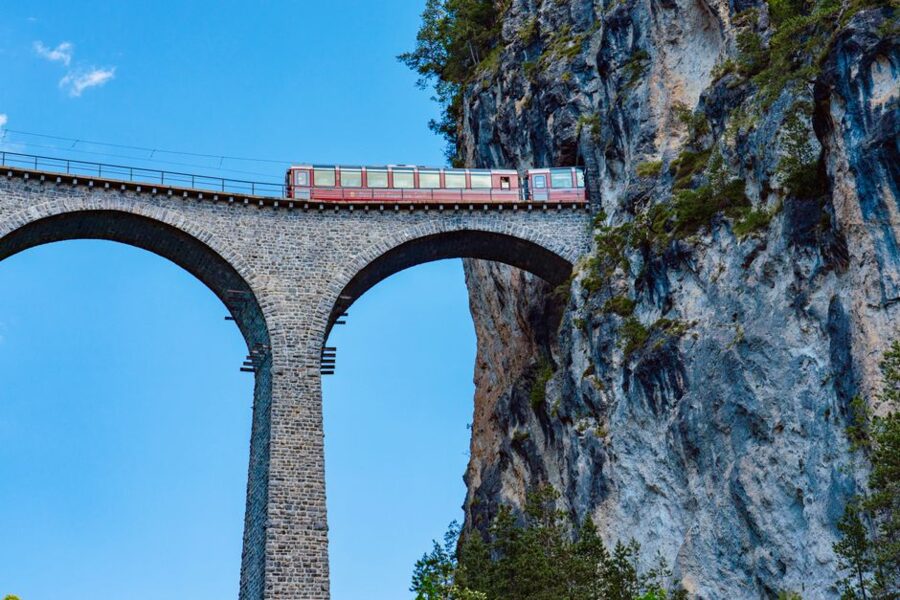
Out of Chur the train follows the Rhine to Bonaduz and Rhäzüns, then runs up the Domleschg valley to Thusis (8:50 a.m.) and follows the Albula toward Tiefencastel (9:08 to 9:14 a.m.). The Landwasser Viaduct comes up just before Filisur (9:29 a.m.). It curves on a radius of only 330 feet (100 m), so from the inside of the curve you can watch the front of the train disappear into the cliff tunnel ahead.
Bergün to Preda and through the Albula Tunnel
From Bergün (9:44 a.m.) the climb to Preda is the engineering heart of the Albula line, spiral tunnels and viaducts stacked on top of each other in a larch forest. Watch for a stretch of track below you that you were on a few minutes earlier. Then the Albula Tunnel carries you under the pass and out into the Val Bever at Spinas, and the train runs down to Samedan and across to Pontresina (10:20 to 10:25 a.m.), where the Bernina line begins.
Pontresina to the Bernina Pass: Montebello and the glaciers
Above Pontresina the line swings through the Montebello curve, where the train turns to face the Morteratsch Glacier and the peaks of the Bernina range. The glacier has pulled back so far that its front, once right by Morteratsch station, can no longer be seen from there: it had retreated more than 9,200 feet (2,800 m) by 2016. The Bernina Express calls at Bernina Diavolezza (10:42 a.m.), the stop for the cable car up to Diavolezza.
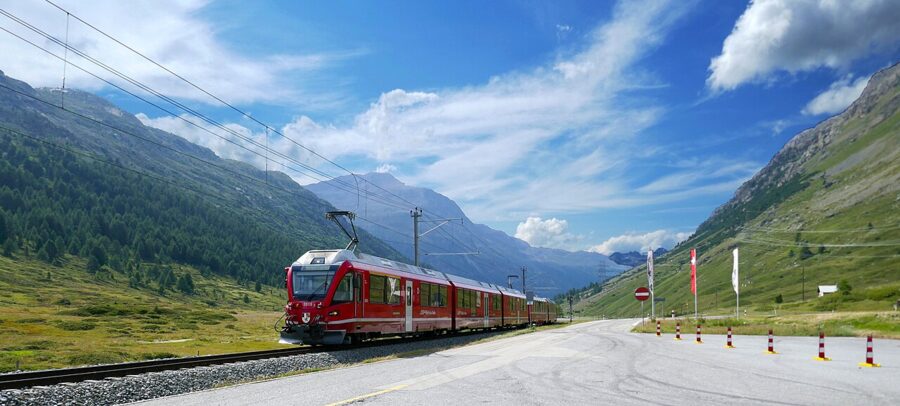
Lago Bianco and Ospizio Bernina, 7,392 feet
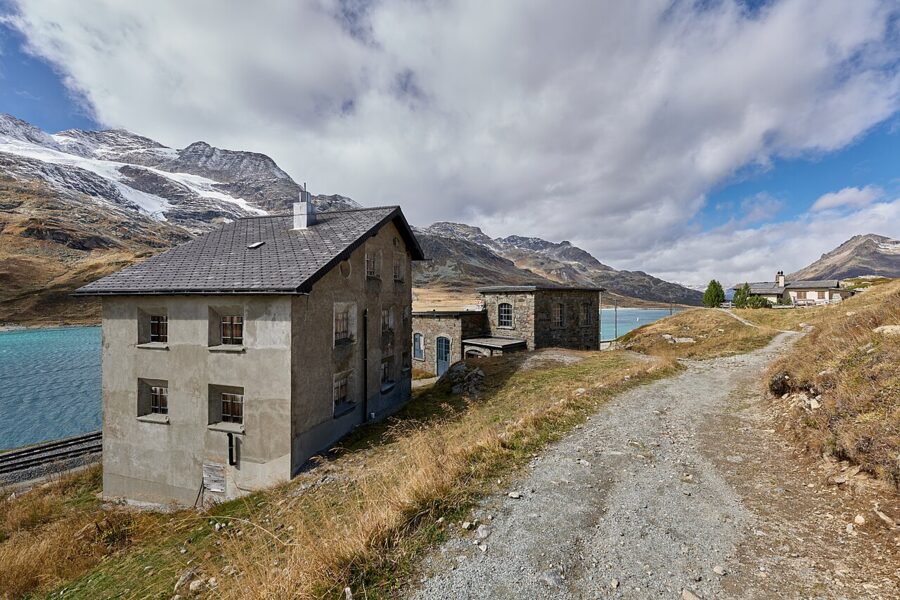
Past the small dark lake of Lej Nair, the track runs onto the shore of Lago Bianco, a reservoir dammed at both ends in 1910 and 1911 to feed the hydro plants in the valley below. Its milky color comes from glacier silt. Ospizio Bernina, halfway along, is the highest station on the whole Rhaetian Railway, and the regional trains stop there while the Bernina Express usually slides through.
Alp Grüm and the drop to Cavaglia
At Alp Grüm (11:06 to 11:15 a.m.) the train stops long enough to get out. The station sits on a 180-degree bend, which gives it a long view of the Palü Glacier, Lago Palü and down the whole Val Poschiavo. Cavaglia, the next station, is about 1,300 feet (400 m) lower and about a mile (1.5 km) away in a straight line, and nearly 4 miles (6 km) away by rail, through tight curves and a spiral tunnel.
The stop length varies by train. Northbound, the 10:06 a.m. from Tirano waits 16 minutes at Alp Grüm, while the 2:24 p.m. stops for just three.
Poschiavo, Le Prese and the lake
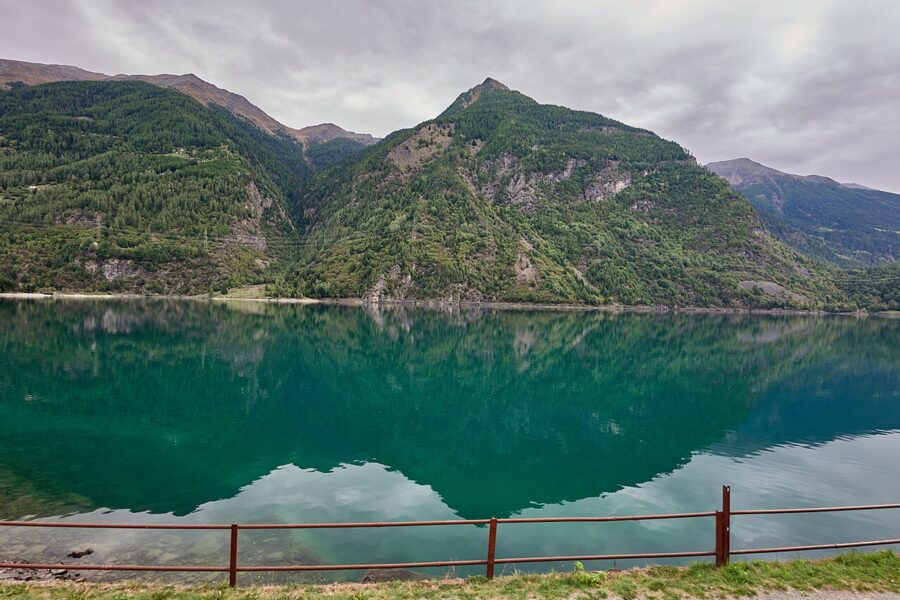
By now the language has changed: the Val Poschiavo is Italian-speaking Switzerland. The train stops at Poschiavo (12:01 to 12:10 p.m.), a town of stone houses around a piazza, then at Le Prese (12:20 p.m.) and runs along the shore of Lago di Poschiavo, which on a still morning holds the whole valley upside down.
The Brusio spiral viaduct and into Tirano
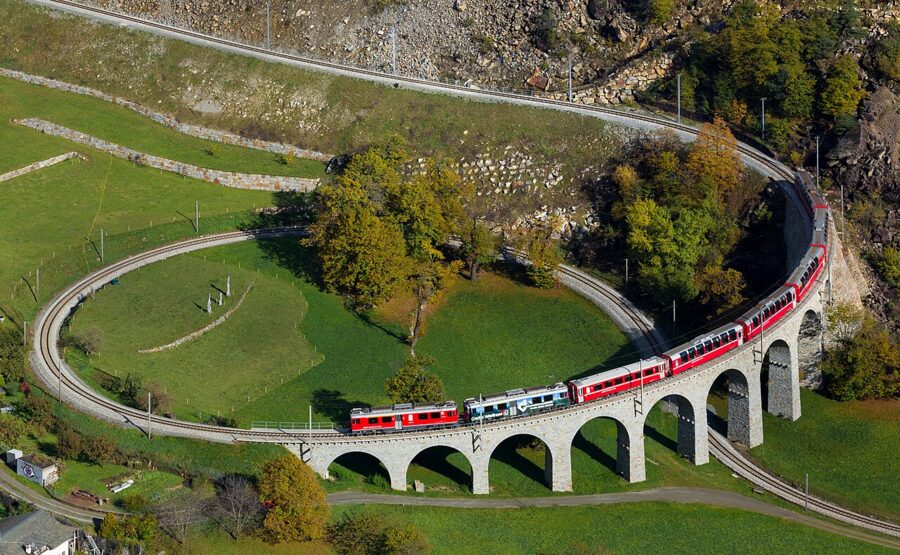
Just below Brusio the valley floor drops too fast for a 7 percent grade, so in 1908 the builders laid the track in a full circle, part of it on a stone viaduct. A spiral tunnel was the first plan, but the rock was not good enough. The viaduct has nine arches of 33 feet (10 m) each, is 360 feet (110 m) long and curves on a 230-foot (70 m) radius.
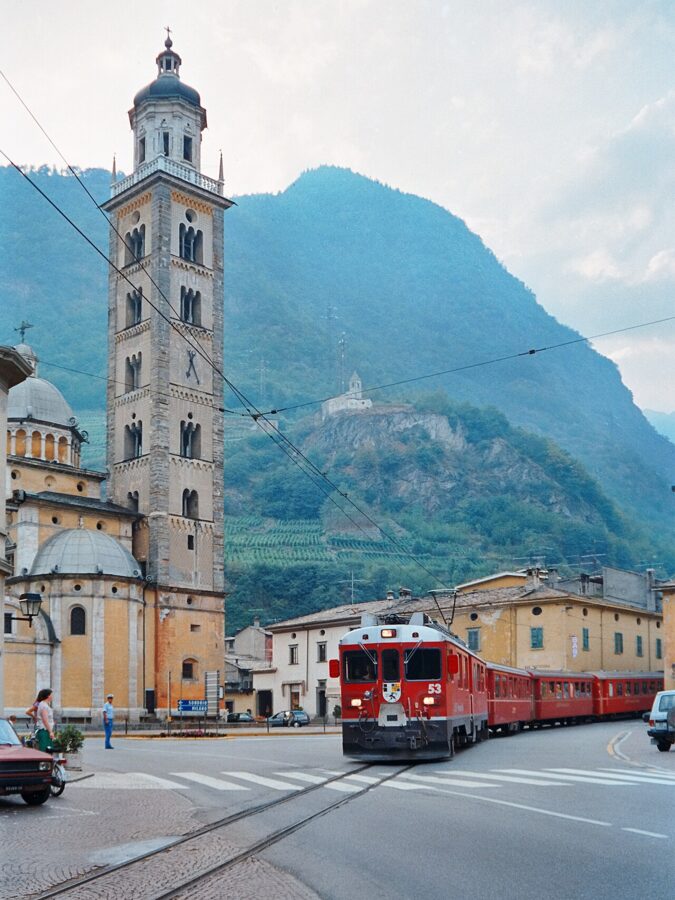
After Campocologno the line crosses into Italy and runs the last stretch to Tirano partly in the street, across the square in front of the Madonna di Tirano basilica. The Bernina Express arrives at 12:50 p.m. at the RhB station, which stands next door to the Italian station on the same square.
Summer, winter and the busy months
Summer gives you the most trains, the longest daylight and the open scenic car in Pullman Class, and it is when every Chur train is at peak reservation price, from April 24 to October 3 in 2027. In October the larches on the Albula climb turn gold.
Winter is the case for snow, and the line runs through it every day. You get one Bernina Express each way from Chur and one each way from St. Moritz, at low-season reservation prices. The Bernina Panorama Winter special trains add extra panoramic cars between St. Moritz and Tirano on set dates, with a CHF 10 (about US$12) reservation, no catering and no InfoT(r)ainment.
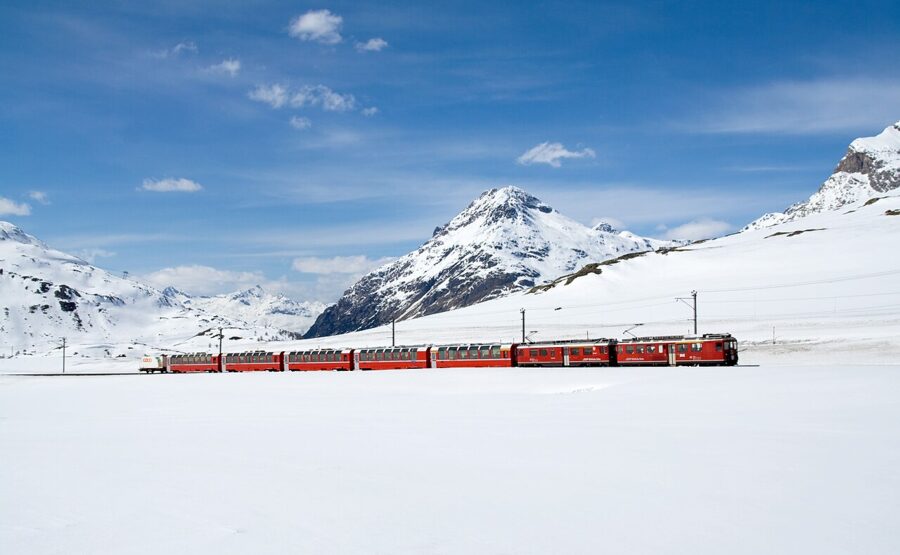
The Panorama Winter dates for 2026 to 2027 are December 5 to 7, December 25 to January 5, and weekends from January 9 to March 21, with no service on March 14 for the Engadin Skimarathon.
The Bernina Express Bus to Lugano
From Tirano, RhB runs a red bus to Lugano that turns the trip into a loop through two countries. It passes the vineyards of the Valtellina and runs along Lake Como to Lugano, where fast trains through the Gotthard Base Tunnel run back north to German-speaking Switzerland.
Bus 5951 leaves Tirano at 2:20 p.m., an hour and a half after the 8:17 a.m. from Chur arrives, and reaches Lugano at 5:30 p.m. Bus 5950 runs the other way, leaving Lugano at 9:45 a.m. and arriving in Tirano at 12:45 p.m., in time for the 2:24 p.m. Bernina Express to Chur. The fare is CHF 41 (about US$49) one way or CHF 82 return, plus a reservation of CHF 16 in low season or CHF 18 in peak, as of 2026; Swiss Travel Pass holders pay only the reservation.
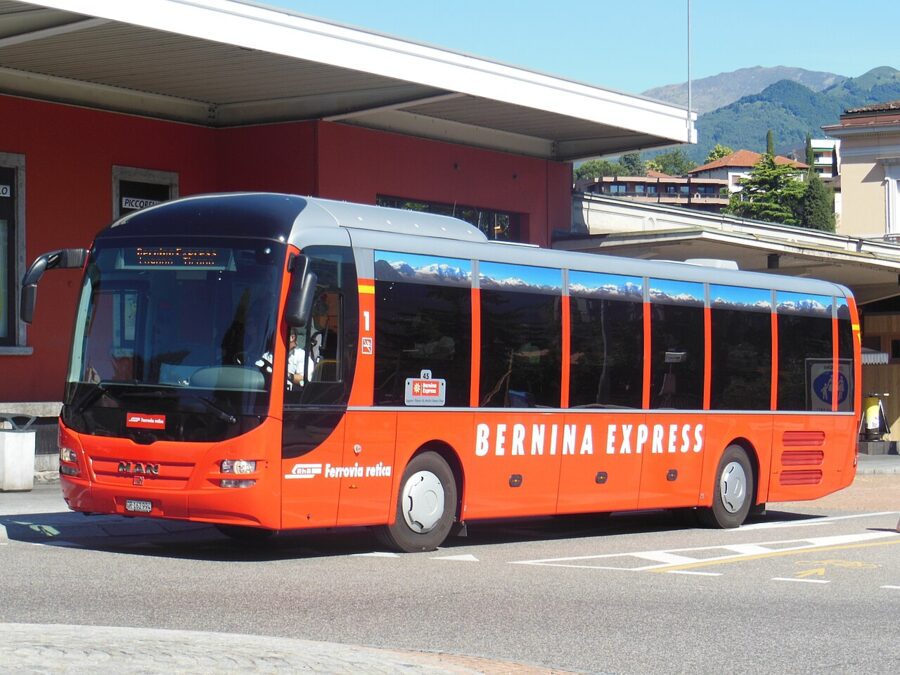
The bus does not run all year. As of 2026 it runs Thursday to Sunday from October 29 to November 22, 2026 and from February 11 to March 21, 2027, then daily from March 25 to October 3, 2027.
Making a day or a night of it
As a day trip from Chur, the 8:17 a.m. out and the 2:24 p.m. back give you an hour and a half in Tirano and close to nine hours on the train. That is a lot of train. I would rather ride one way, sleep in Poschiavo or Tirano, and come back the next morning on the regional train, getting off at Alp Grüm or Ospizio Bernina to walk a stretch.
From St. Moritz in summer, the day trip is easy: the 9:17 a.m. reaches Tirano at 11:32 a.m., and the 1:17 p.m. or 4:06 p.m. bring you back. With the 4:06 p.m. you have time for lunch in Tirano and a look inside the basilica.
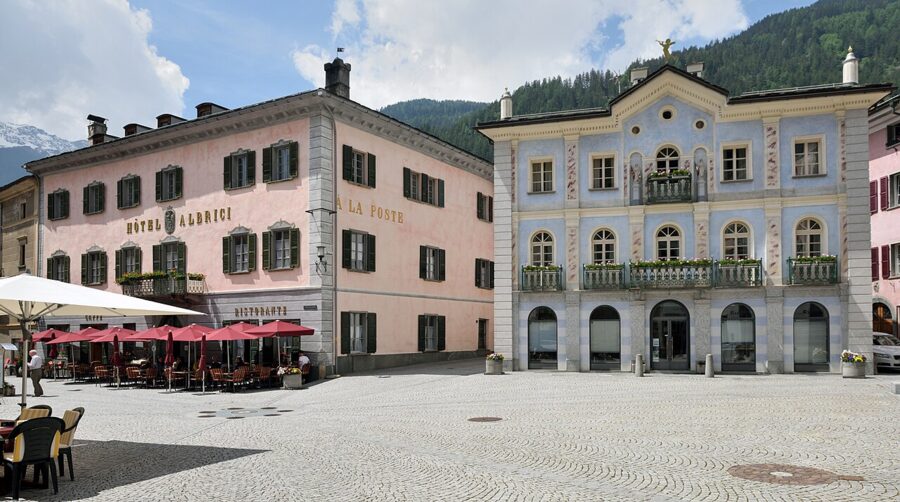
For a meal, the RhB winter offer’s partner list gives a short list of places open in the 2026 to 2027 season. In Poschiavo, that includes the Albergo Ristorante Croce Bianca on Via da Mezz and Hotel Albrici on the piazza; in Tirano, the Hotel Ristorante Bernina on Via Roma and the Ristorante Parravicini. Check their winter closing weeks before you plan a lunch around them.
Tirano also works as a door into Italy. Trenord regional trains leave from the Italian station next to the RhB platforms for Sondrio, Lecco and Milano Centrale, so you can link the Bernina Express to a trip through Italy by train. Coming the other way, the Glacier Express runs between Zermatt and St. Moritz, and the two together make a two-day crossing of the Swiss Alps; both sit among Europe’s great scenic rides.
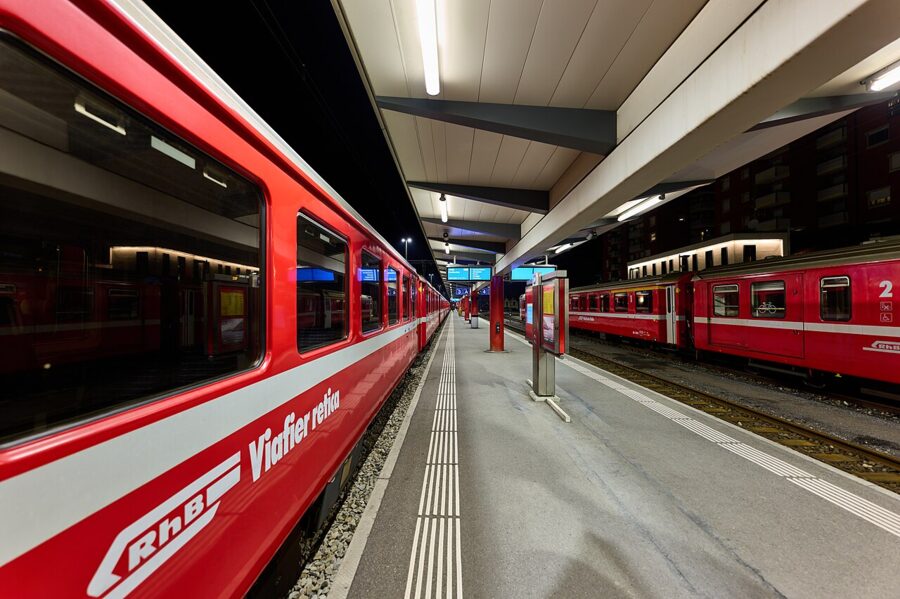
Getting to Chur from farther away is straightforward. From London, Eurostar to Paris connects with the TGV Lyria trains to Switzerland from Gare de Lyon, and the night trains into Zurich come from Amsterdam, Hamburg, Berlin and Vienna. For a third scenic run, the GoldenPass Express crosses from Montreux to Interlaken.
On board, and what to bring
Luggage space on the Bernina Express is limited to a few racks. Bring a day bag and send the big suitcases ahead with the baggage delivery service RhB recommends, or leave them in station lockers; in Pullman Class there is almost no room at all. Bicycles are not allowed on the Bernina Express, though they can go on the regional trains on the same line.
Payment on board is cashless only. The trolley brings snacks and drinks, with or without alcohol, to your seat, and you can bring your own food. There is no dining car.
Small dogs up to 12 inches (30 cm) at the shoulder ride free in a carrier, larger dogs need a dog ticket, and either way bring the papers for the Italian border. Some seats are wheelchair accessible, with an accessible toilet in first class, and they can only be booked through RhB’s Railservice, along with boarding help from SBB in advance.
Take the right side out of Chur, keep your eyes up for the loop above Bergün, and get off at Alp Grüm for those nine minutes even in the snow. Then book the next one before you leave Tirano.