The 7:30 a.m. Afrosiyob leaves Tashkent North with Samarkand two hours and thirteen minutes ahead and Bukhara two more beyond it. It is the train everyone wants, and it fills accordingly. Two weeks before a December departure, the business coach on that train was down to its last six seats.
That is Uzbekistan by rail in short: fast, cheap by any Western measure, and short on seats. Three kinds of train share the Silk Road line from Tashkent. The Spanish-built Afrosiyob runs to Samarkand, Bukhara and Karshi, the Korean-built Jaloliddin Manguberdi has run on to Urgench and Khiva since May 2026, and the older locomotive-hauled day trains and sleepers fill the gaps for half to two-thirds of the fare.
The choice you actually make is not which city to see. It is which train, which class and which morning, and whether a seat is left on it. Get those right and Tashkent, Samarkand, Bukhara and Khiva string together without a single bus.
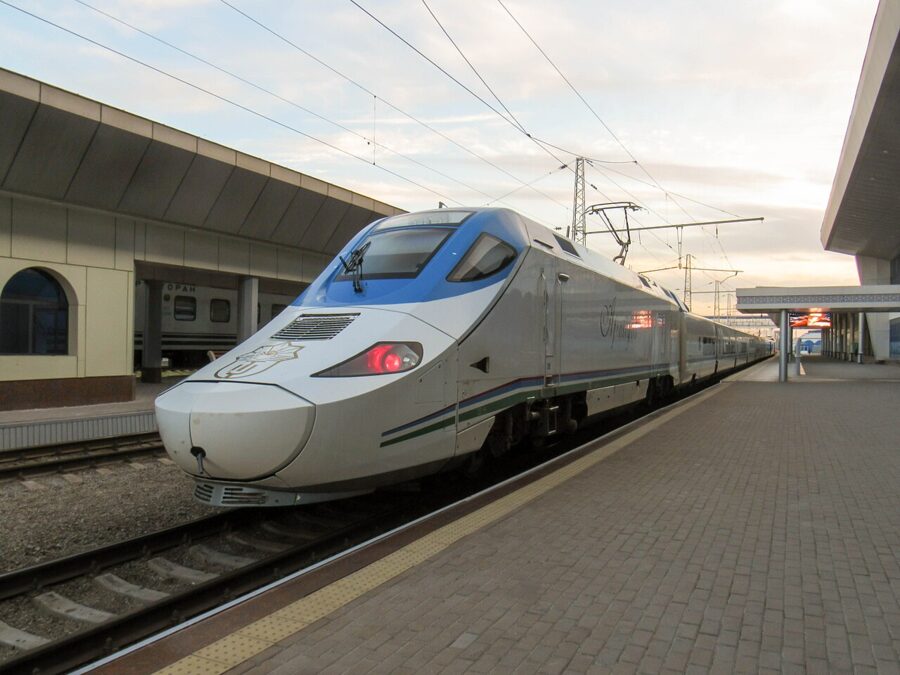
None of this is a tour train, and the fares show it. An economy seat from Tashkent to Samarkand costs 311,000 som (about US$26) as of 2026, set by the railway and the same on a quiet Tuesday as on a holiday weekend. The low, fixed price is exactly why seats run out: there is no fare high enough to ration them, only the calendar.
The trains on the Silk Road line
Every passenger train in the country is run by Uzbekistan Railways (O’zbekiston Temir Yo’llari), the state company. It names its trains, and the name on the booking screen tells you most of what you need: speed, seating and roughly what it will cost.
Afrosiyob: the high-speed shuttle
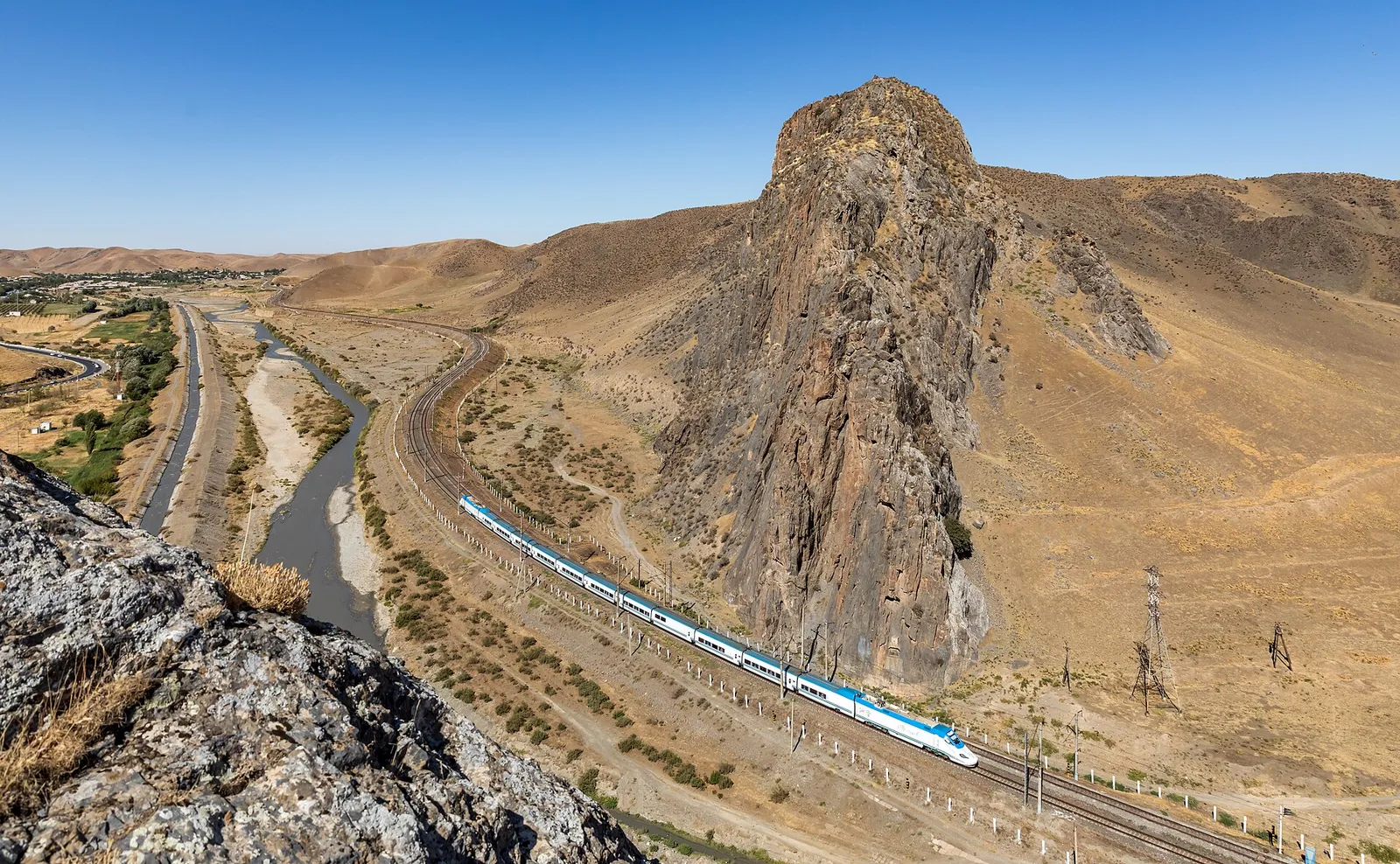
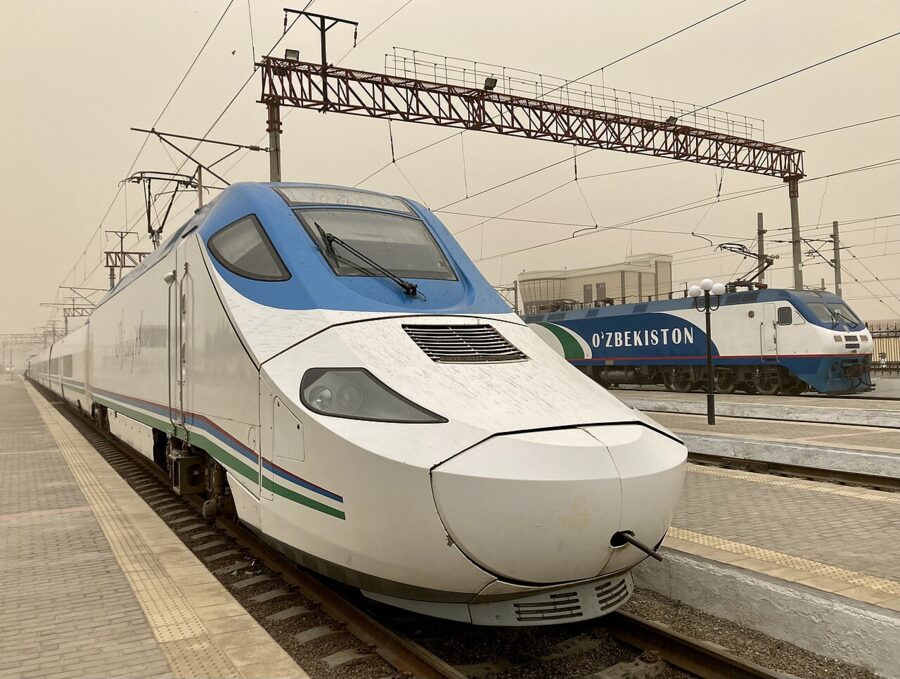
The Afrosiyob is a Talgo 250, built in Spain, and it has run between Tashkent and Samarkand since 2011. The line was extended to Bukhara in 2016, and some trains branch south to Karshi and, on Sundays, Shakhrisabz. Tashkent to Samarkand is 214 miles (344 km), and the fastest trains cover it in a little over two hours.
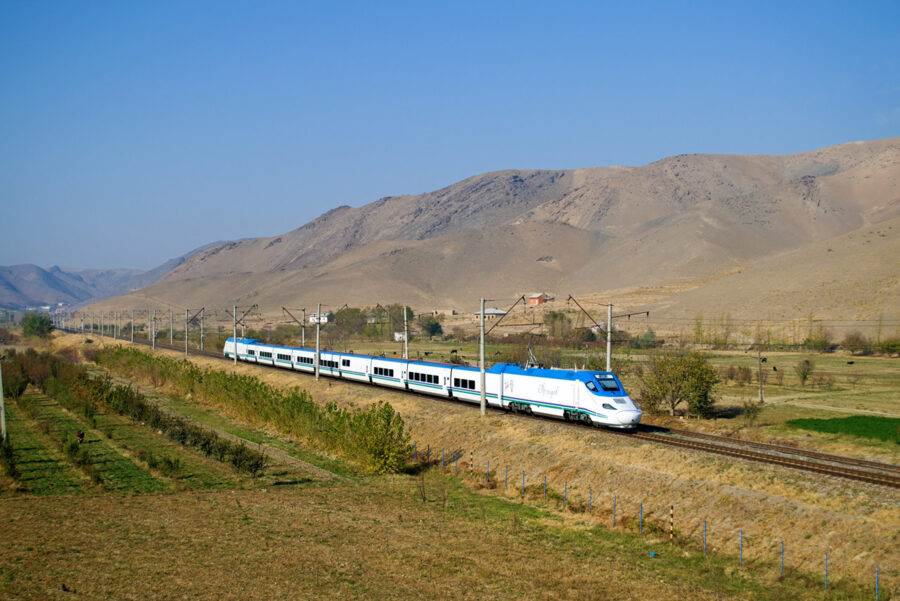
Inside it feels like a European intercity train of the 2000s: reclining seats, a café car, sliding doors that close quickly at stops. Economy seats run two and two, business two and one, and a few departures carry a small VIP section. A snack and a hot drink come with the ticket, and the onboard Wi-Fi asks for a code sent by text to an Uzbek phone number, so download what you want to watch before you board.
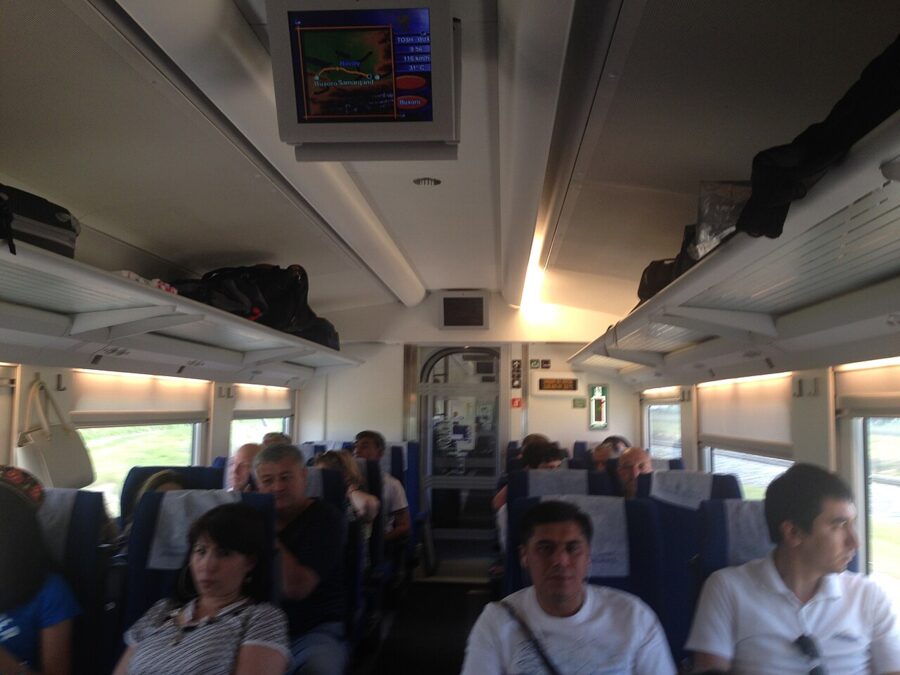
Jaloliddin Manguberdi: the new train to Khiva
The line west of Bukhara, across the Kyzylkum to the Khorezm oasis, was electrified for high-speed trains with Asian Development Bank money, and the service was promised for 2024. It finally opened on May 5, 2026, with Hyundai Rotem trainsets named after Jalal ad-Din, the last shah of Khwarazm, whose old kingdom the train now serves. The launch timetable was three trips a week each way, and by late 2026 the train was running every day.
The run is 635 miles (1,022 km), Tashkent North to Khiva with stops at Samarkand, Bukhara and Urgench, in about seven and a half hours. In December 2026 it leaves Tashkent at 7:00 a.m., calls at Samarkand at 9:13 a.m. and Bukhara at 10:54 a.m., and reaches Khiva at 2:42 p.m. From January 2027 the booking system shows it leaving at 6:55 a.m. and arriving at 2:58 p.m. It sells economy and business.
This is the train that changed the trip. Before it, Khiva meant either a night on a sleeper or a flight to Urgench, and most short itineraries simply dropped it. Now you can leave Bukhara late in the morning and be inside the walls of Itchan Kala for the late-afternoon light.
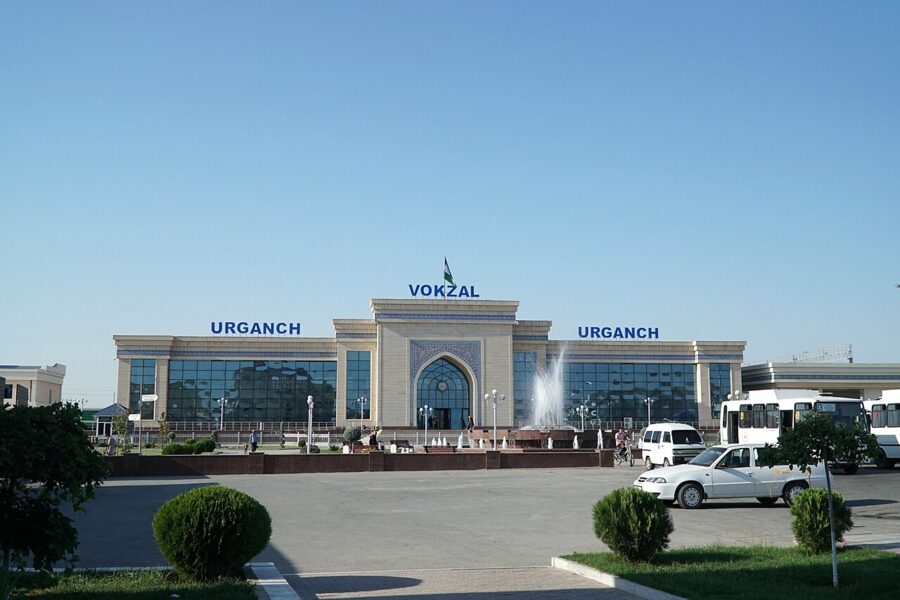
Sharq, Nasaf and the day expresses
Sharq (“East”) is the older day train between Tashkent and Bukhara: a locomotive and a string of Soviet-pattern coaches, sold as seats rather than berths. It takes about three hours ten minutes to Samarkand and six hours to Bukhara. Nasaf is its sister on the Karshi branch, with the same seating and nearly the same times as far as Samarkand.
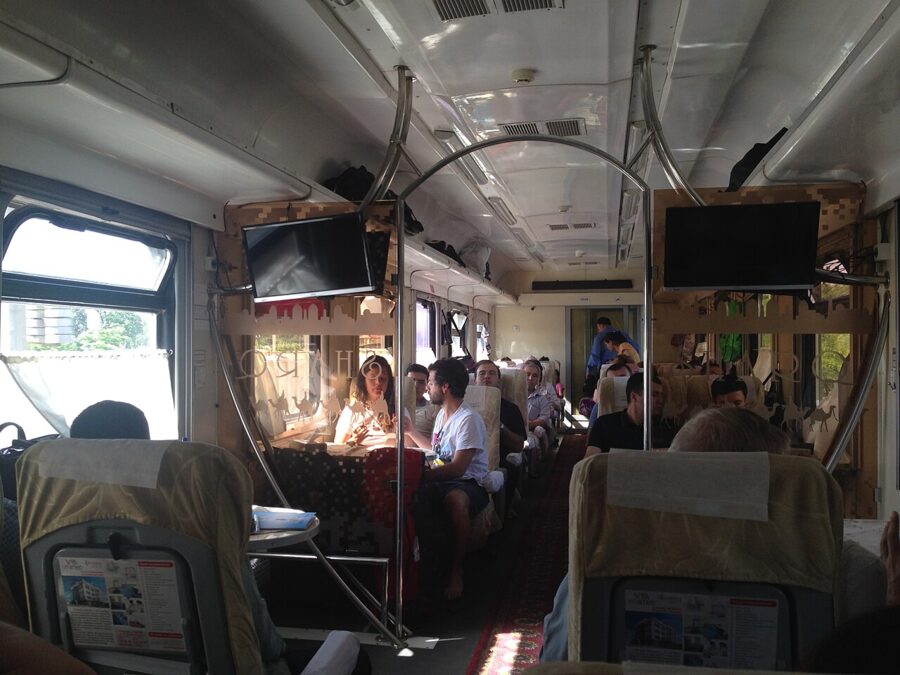
I would take the Sharq without a second thought on Samarkand to Bukhara, where the time difference is small, and as a fallback on Tashkent to Samarkand. The 8:37 a.m. from Tashkent North reaches Samarkand at 11:46 a.m. and Bukhara at 2:35 p.m., which still leaves an afternoon in either city.
The sleepers
The overnight trains are the long-distance workhorses: Tashkent to Khiva, Urgench and Kungrad in the west, and Termez in the south. Most of them leave from Tashkent South, not the main station, and they carry the three classic sleeping-car types that Uzbekistan Railways lists for its fleet.
- Platzkart (shown as “Sleeper” on the English booking site): an open car of 54 berths in bays of four plus two along the corridor. Cheapest, busiest, and the one with the least sleep.
- Coupe (kupe): a closed compartment with four berths, two up and two down, and a door that locks.
- SV: a two-berth compartment, the first-class sleeper, sold on only some trains.
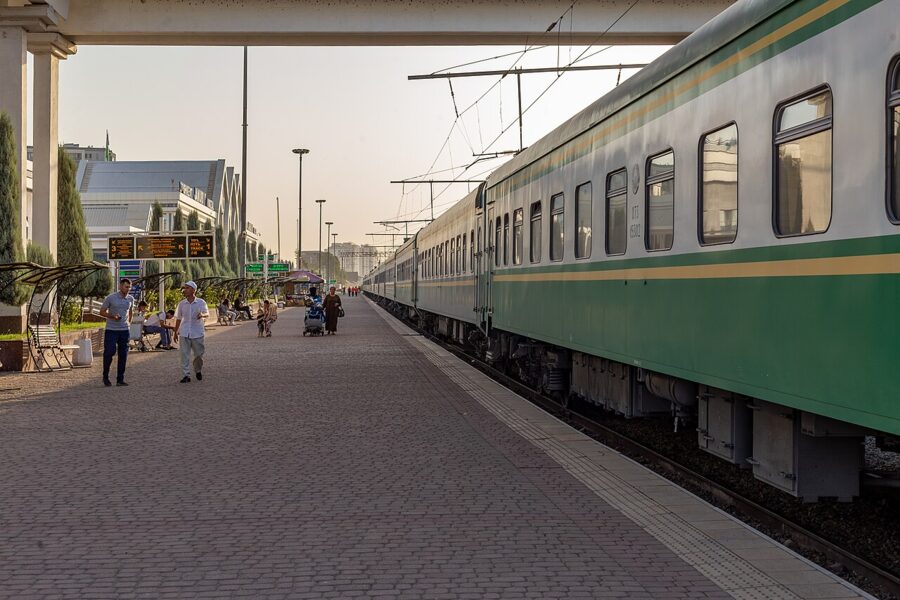
Bedding comes in a sealed bag and you make your own bed. Each car has a hot-water boiler, so bring tea or coffee and a cup. On the train to Khiva I would book coupe; on a short hop like Tashkent to Samarkand, where the sleepers arrive in the middle of the night, I would not book a sleeper at all.
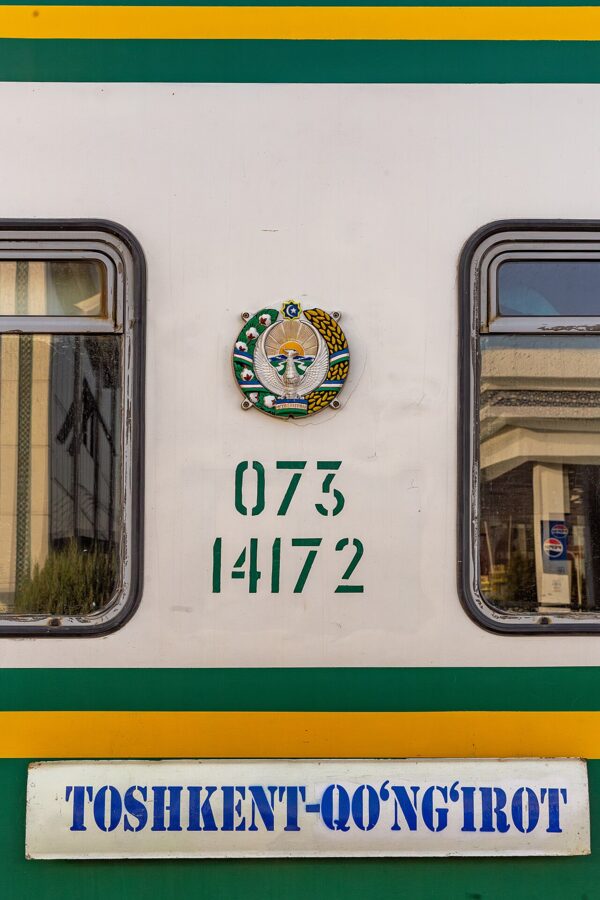
The Khiva sleeper, train 056, leaves Tashkent South at 9:45 p.m. four nights a week and arrives in Khiva around midday. It is the slow way to arrive, but a coupe berth all the way from Tashkent costs about the same as the Bukhara-to-Khiva leg alone on the high-speed train, and it saves a night’s hotel. If you have ridden the night trains in Europe, the rhythm is familiar, in older cars.
Routes and times as of December 2026
The table shows the trains a visitor is most likely to use, with times from the Uzbekistan Railways timetable and booking system for December 2026. Times move by a few minutes when timetables change, and the January 2027 Khiva train is a few minutes earlier, so check the exact train when you book.
| Train | Departs | Arrives | Runs |
|---|---|---|---|
| Afrosiyob 766 | Tashkent North 7:30 a.m. | Samarkand 9:43 a.m., Bukhara 11:39 a.m. | Daily |
| Afrosiyob 768 | Tashkent North 7:55 a.m. | Samarkand 10:25 a.m. | Daily |
| Afrosiyob 770 | Tashkent North 8:30 a.m. | Samarkand 10:49 a.m., Bukhara 12:36 p.m. | Daily |
| Afrosiyob 772 | Tashkent North 7:48 p.m. | Samarkand 10:13 p.m., Bukhara 12:01 a.m. | Daily |
| Jaloliddin Manguberdi 752 | Tashkent North 7:00 a.m. | Samarkand 9:13 a.m., Bukhara 10:54 a.m., Khiva 2:42 p.m. | Daily |
| Sharq 710 | Tashkent North 8:37 a.m. | Samarkand 11:46 a.m., Bukhara 2:35 p.m. | Daily |
| Sharq 712 | Tashkent North 8:32 p.m. | Samarkand 11:41 p.m., Bukhara 2:27 a.m. | Daily |
| Sleeper 056 | Tashkent South 9:45 p.m. | Bukhara about 5:10 a.m., Khiva around midday | Tue, Wed, Fri, Sat |
| Afrosiyob 767 | Samarkand 5:40 p.m. | Tashkent North 8:07 p.m. | Daily |
| Afrosiyob 769 | Bukhara 3:03 p.m. | Tashkent North 7:17 p.m. | Daily |
| Afrosiyob 765 | Bukhara 4:16 p.m. | Tashkent North 8:30 p.m. | Daily |
| Sharq 709 | Bukhara 4:51 p.m. | Tashkent North 11:06 p.m. | Daily |
| Sleeper 056 | Khiva 6:00 p.m. | Tashkent South 8:22 a.m. | Wed, Thu, Sat, Sun |
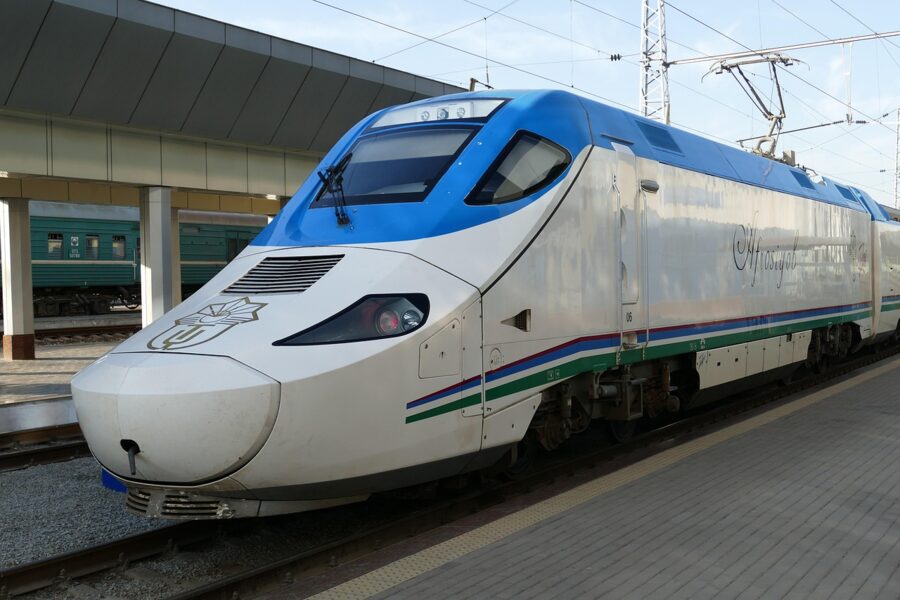
Yes, direct trains link Tashkent and Samarkand, more than a dozen a day if you count the sleepers passing through at night. For a daytime trip the useful ones are the five morning Afrosiyob and Jaloliddin departures between 6:33 and 8:30 a.m., the 8:37 a.m. Sharq, the 8:58 a.m. Nasaf, and the 7:48 p.m. Afrosiyob if you want to arrive for dinner.
Samarkand to Bukhara is just as easy. Every train in the table that continues past Samarkand takes under two hours by Afrosiyob and about three by Sharq. Bukhara back to Tashkent is the afternoon bank of Afrosiyob trains between 3:03 and 4:16 p.m., plus a Friday-to-Sunday extra at 6:08 p.m. and a 3:27 a.m. train that reaches Tashkent at 7:42 a.m.
Further afield, Urgench and Khiva now have a local electric train as well. Since late summer 2026 a Chinese-built six-car set has linked Urgench Airport, Urgench and Khiva, at 25,000 som (about US$2) a ride as of 2026. It is the cheapest way to get from a flight to the old town.
Classes and fares
Uzbek train fares are set by the railway and do not climb as a train fills. Uzbekistan Railways raised fares on its Afrosiyob, Sharq and Nasaf trains by 15 percent on February 1, 2026, and published the new Afrosiyob fares by class. The booking site was charging exactly those fares in late November 2026 for December travel.
Prices below are one-way, per adult, as of 2026, in som as charged, with US dollars at the late-November 2026 rate of about 12,000 som to the dollar. You pay in som by card.
| Route and train | Class | Fare (som) | About (US$) |
|---|---|---|---|
| Tashkent to Samarkand, Afrosiyob | Economy | 311,000 | $26 |
| Tashkent to Samarkand, Afrosiyob | Business | 455,000 | $38 |
| Tashkent to Samarkand, Afrosiyob | VIP | 709,000 | $59 |
| Tashkent to Bukhara, Afrosiyob | Economy | 509,000 | $42 |
| Tashkent to Bukhara, Afrosiyob | Business | 760,000 | $63 |
| Tashkent to Bukhara, Afrosiyob | VIP | 1,138,000 | $95 |
| Tashkent to Samarkand, Sharq or Nasaf | Seat | 200,060 | $17 |
| Tashkent to Bukhara, Sharq | Seat | 276,820 | $23 |
| Bukhara to Khiva, Jaloliddin Manguberdi | Economy | 332,000 | $28 |
| Bukhara to Khiva, Jaloliddin Manguberdi | Business | 490,000 | $41 |
| Tashkent to Khiva, sleeper 056 | Platzkart / coupe / SV | 245,140 / 348,550 / 640,390 | $20 / $29 / $53 |
| Bukhara to Khiva, sleeper | Platzkart / coupe / SV | 157,100 / 210,660 / 364,390 | $13 / $18 / $30 |
Which class is worth it? On the Afrosiyob, economy is fine for two hours. Business buys a 2+1 layout and a quieter car for about $12 more to Samarkand, and I would pay it on the four-hour run to Bukhara. VIP is a small compartment of seats at the front of some trains; it costs more than twice the economy fare, and I would only book it if it were the last thing left.
Is it cheaper to buy in advance? Not on these trains. The fare for a given class does not change with the booking date, so booking early buys you a seat, not a discount. What matters is getting one.
Booking on the Uzbekistan Railways site
Book directly with the railway. The official booking site (eticket.railway.uz, which now forwards to eticket.uzrailpass.uz) has an English version, and the railway’s own app, Uzrailway tickets, does the same job on a phone. Resellers and agencies sell the same seats with a markup on top.
The steps are plain enough once you have done them once:
- Make an account a few days before your booking day. Registration asks for an email address, and some new accounts have trouble checking out on the first try, so do not leave it to the morning seats are released.
- Search by city, then check the station. Afrosiyob, Jaloliddin and Sharq trains use Tashkent North; the sleepers use Tashkent South. The results page shows both.
- Pick the coach and seat. On the high-speed trains you choose a numbered seat; on the sleepers you choose a berth, upper or lower.
- Enter each passenger exactly as on the passport, with the passport number. The name and number are checked against your passport at the station.
- Pay quickly. The seat is held only for a short time while you pay, about 15 minutes, and a card your bank blocks as foreign will lose it. Have your banking app open to approve the payment.
The ticket arrives as an e-ticket with a QR code. You do not need to print it; the guard at the station entrance scans the code on your phone and looks at your passport.
How early, and the sell-out problem
This is the part that catches people. In late November 2026 the sleepers and the Sharq were on sale more than two months ahead, into February 2027, while the Afrosiyob and Jaloliddin trains showed no seats at all six weeks out. Two weeks out, the December high-speed trains still had economy seats, but the business coaches were down to a handful each.
The high-speed trains are where demand piles up. Tour operators reserve blocks of seats months ahead for their groups, Sunday evenings are busy with people heading back to Tashkent, and before New Year the railway has added extra Afrosiyob runs for passengers who could not get a seat on the regular ones.
My advice is simple. Check the booking site every few days from about seven weeks before your trip, and book the day your train appears. If your morning Afrosiyob is gone, look at the Jaloliddin (it stops at Samarkand and Bukhara too, and is easily missed), then the Sharq, before you give up and hire a car.
Stations: where you board
Tashkent North and Tashkent South
Tashkent has two long-distance stations, and taking the wrong one is the classic mistake. Tashkent North, also called Tashkent Central (Toshkent Shimoliy in Uzbek), is the big station near the center with its own metro stop, Toshkent. Every Afrosiyob, Jaloliddin, Sharq and Nasaf leaves from here.
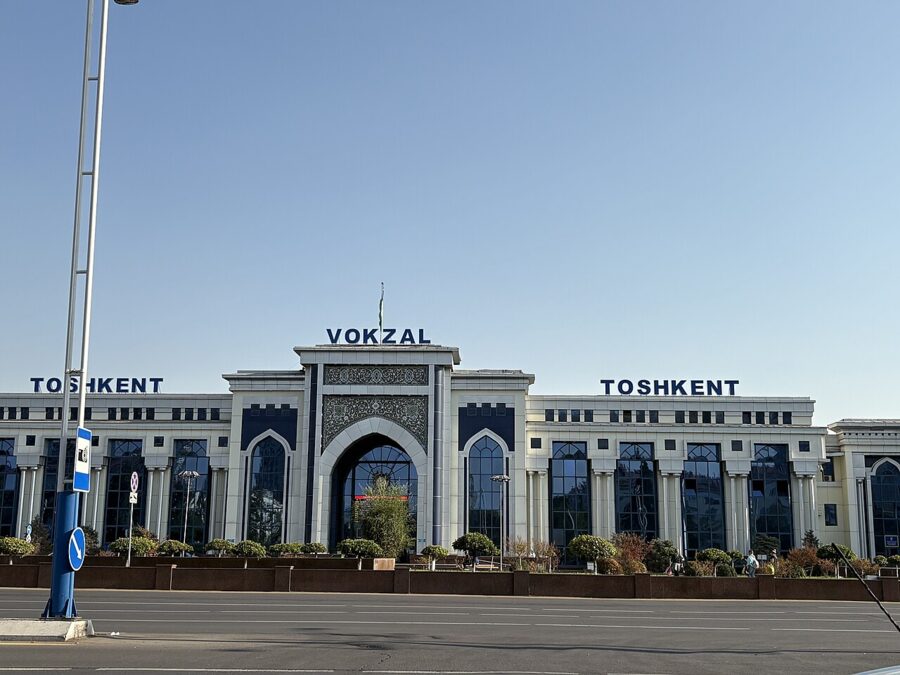
Tashkent South (Toshkent Janubiy) is across town, and it handles most of the overnight trains to Khiva, Urgench, Kungrad and Termez. The booking site prints the station on the ticket. Allow a good half hour by taxi between the two, more in the evening rush.
Samarkand
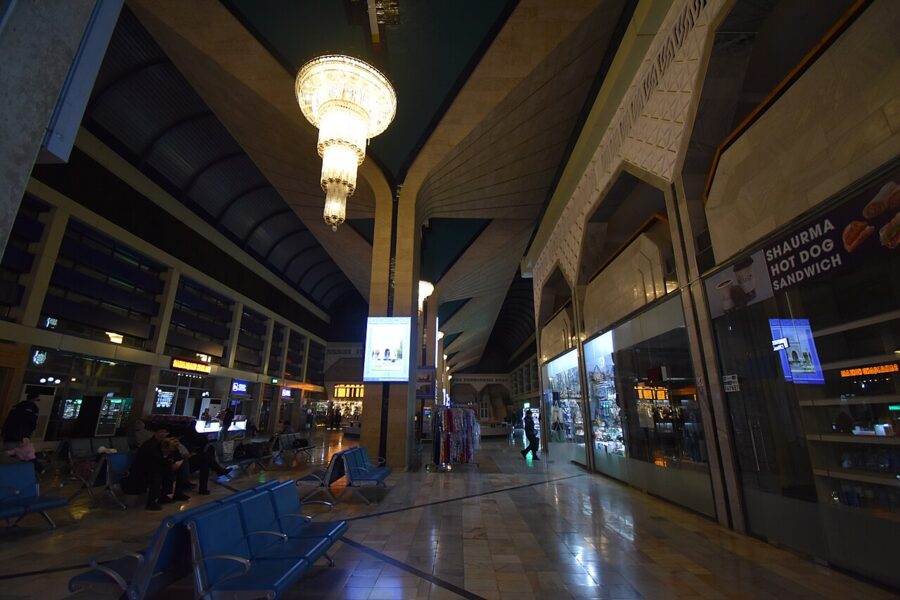
Samarkand station is a long modern building on the edge of the newer city, a taxi ride from the Registan rather than a walk. It is one of the calmer places to wait in the country, with a big hall and somewhere to buy coffee before the train.
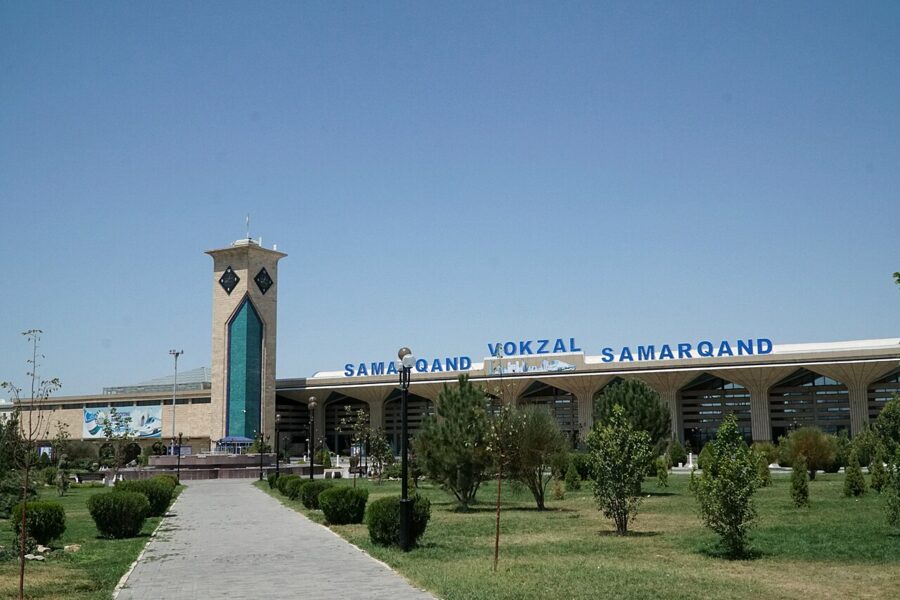
Bukhara (Kagan)
Bukhara’s station is not in Bukhara. It is Bukhara-1, in the separate town of Kagan to the southeast, and the old city is a taxi ride away. Build that into any plan with a tight check-in or a guided tour.
Urgench and Khiva
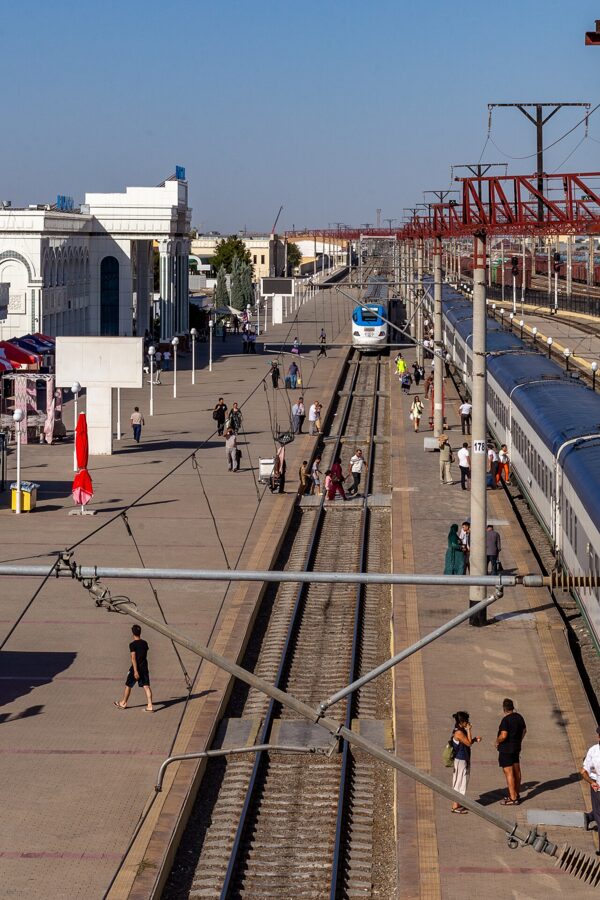
Khiva has its own station at the end of the line, outside the walls of the old town, and it is the terminus for both the Jaloliddin and the Khiva sleepers. Urgench, the regional capital, is the stop before it and has the airport; the local electric train links the airport, the city and Khiva.
Security, luggage and life on board
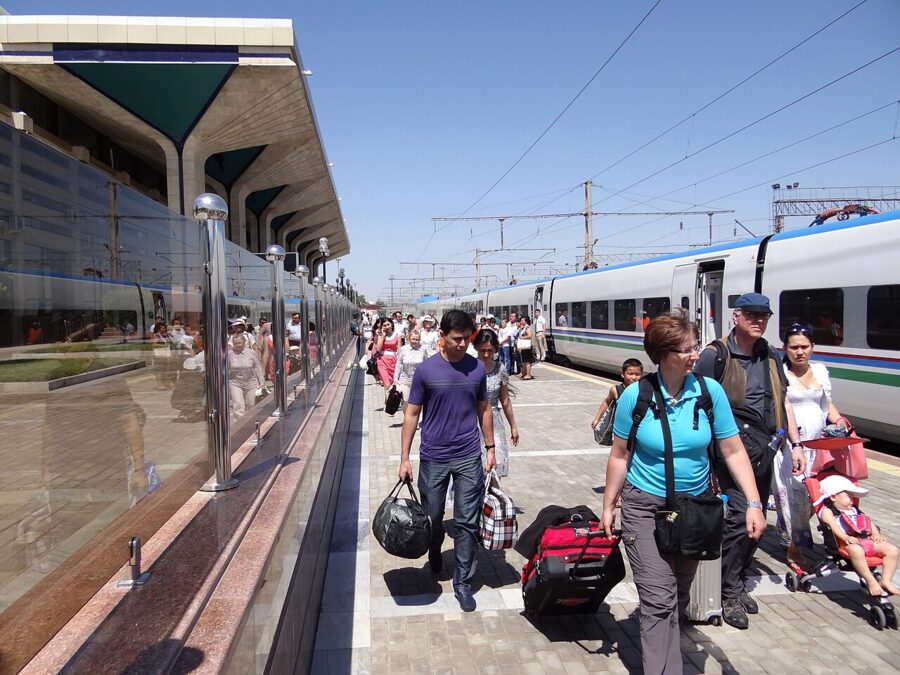
Stations have airport-style screening at the door. Your bags go through an X-ray machine, you walk through a metal detector, and then a guard checks your ticket against your original passport; a photocopy or a photo on your phone will not do. Get there 45 minutes before a high-speed train and an hour before a sleeper from a big station.
Mid-route stops are short, often five to ten minutes, and on some platforms the train is longer than the paved section. Stand where the boards or staff tell you your coach will stop, and be ready, because the Afrosiyob doors close quickly and on time. Porters work the bigger stations for a small tip in som if you are carrying more than you can lift.
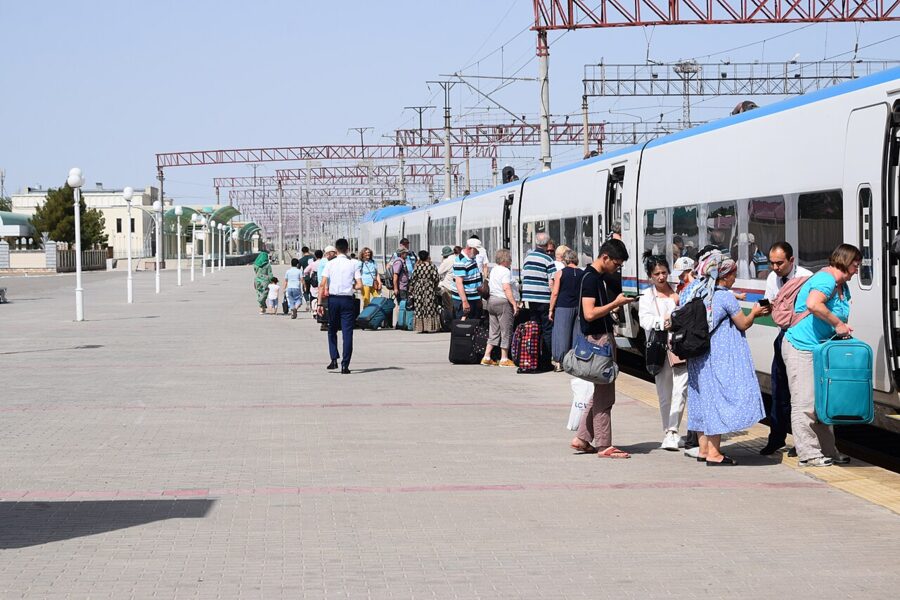
Food is easy. The high-speed trains include a pastry or snack box with tea or coffee, and the café car sells coffee, soft drinks, light meals and ice cream, so carry some som in cash. Fruit offered from a trolley is usually extra, so ask before you take any. On the sleepers, bring dinner and breakfast from a bazaar; the boiler in each car takes care of hot drinks.
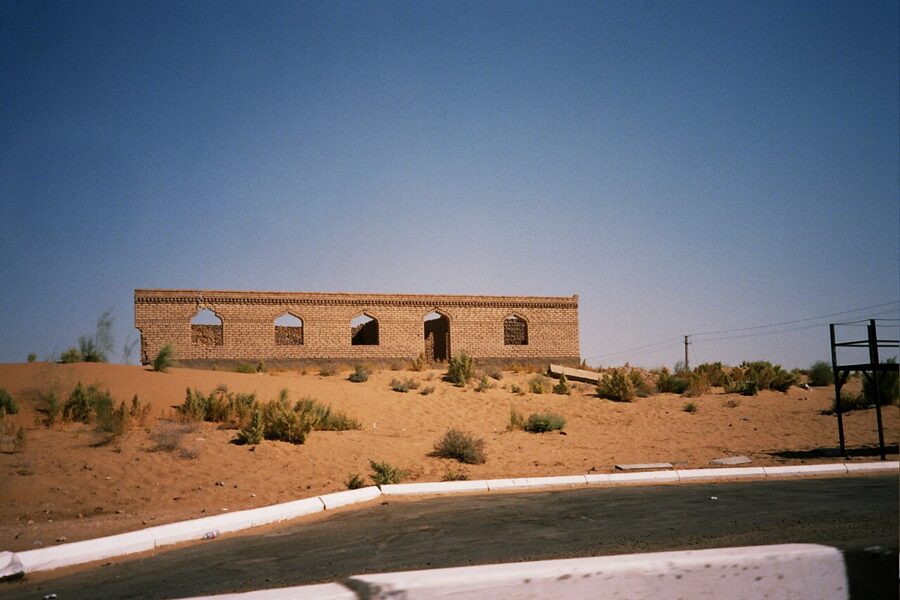
Weather is the other thing to plan for. July and August often reach 95 to 104°F (35 to 40°C) in the desert cities, and the cars are air-conditioned, but the walk along a sunbaked platform at Bukhara is not. Late spring brings the occasional dust storm off the desert, like the one below.
A Silk Road itinerary by rail
Eight days covers the four cities by train, with two nights each in Tashkent, Samarkand and Bukhara and a full day in Khiva. Every leg below uses a train from the table, and the order runs east to west so the long ride comes when you are already in Bukhara.
Days 1 and 2: Tashkent
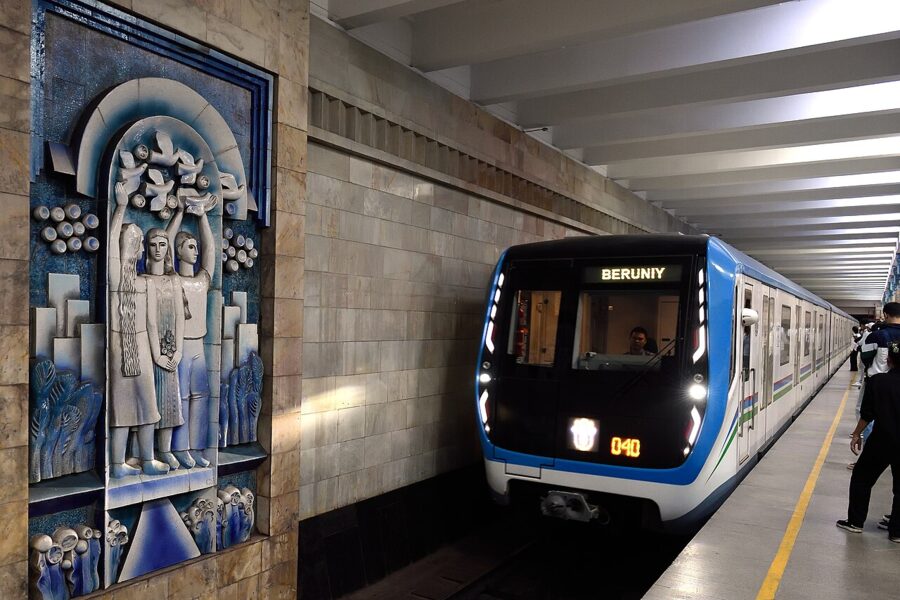
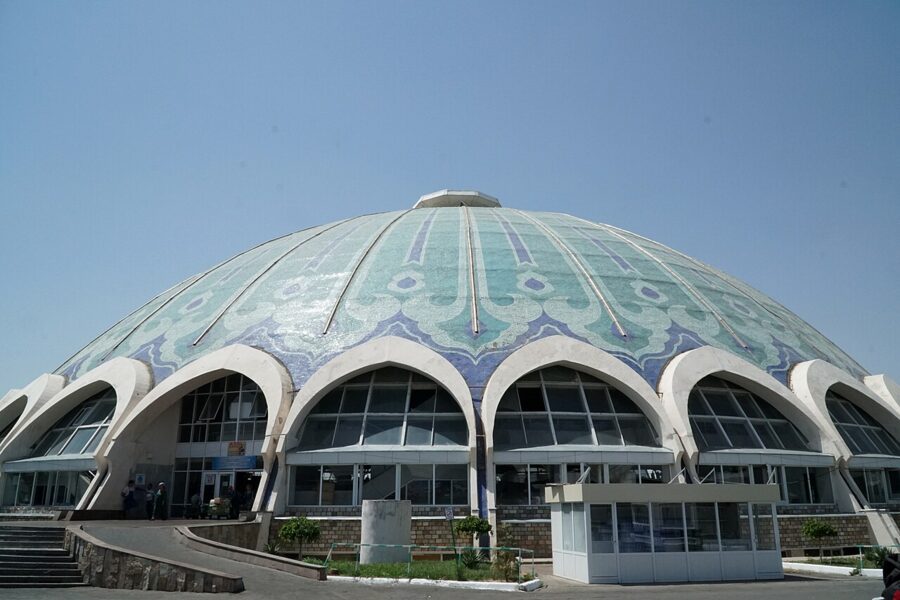
Arrive, sleep, and spend a day on the metro and in the Chorsu Bazaar. Ride the metro out to Toshkent station on your first evening to see where the morning trains leave from, and buy breakfast to carry.
The bazaar is the place to stock up for the trains: dried apricots, nuts, flat bread and fruit travel well, and they beat anything sold on board. Pack a sleeper picnic here if Khiva is in your plan.
Day 3: Afrosiyob to Samarkand
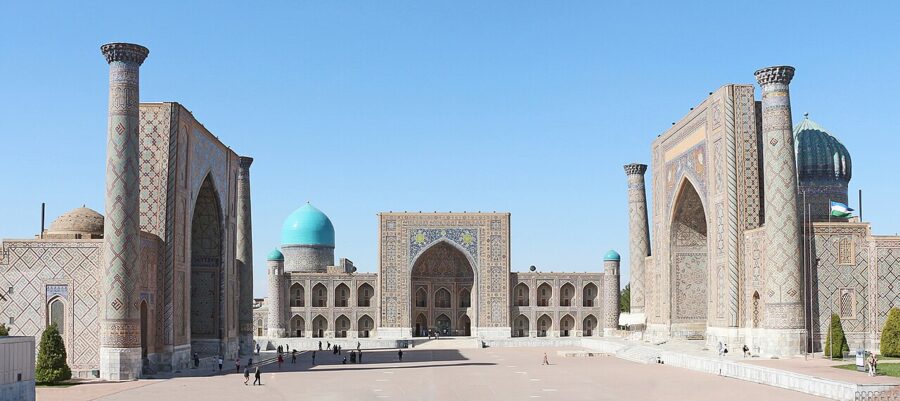
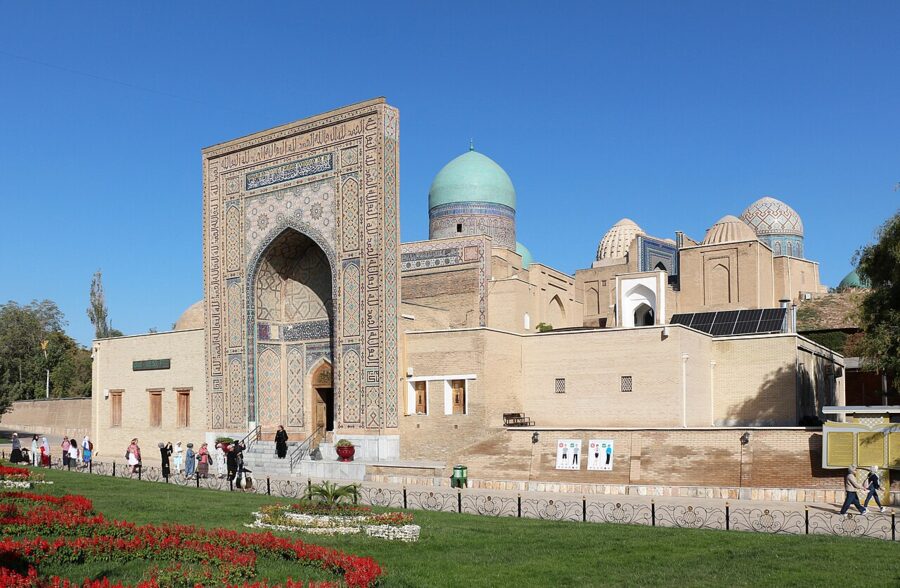
Take the 7:30 a.m. Afrosiyob (or the 7:55 a.m. if it is gone) and be at the Registan by late morning. Samarkand rewards two nights: the Registan, the Gur-e-Amir where Timur is buried, the Shah-i-Zinda necropolis and the Bibi-Khanym mosque.
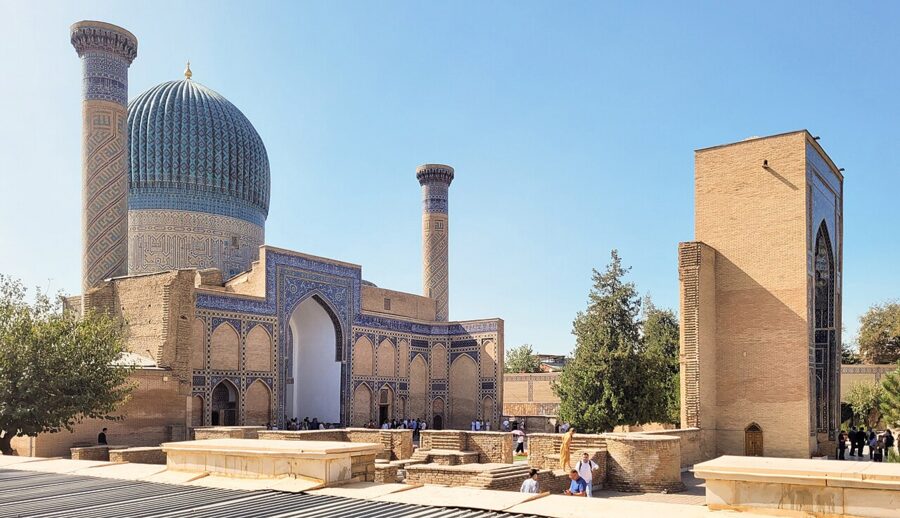
Spend your second Samarkand morning at Shah-i-Zinda, the street of tiled tombs on the hill above the Siab Bazaar. It is the one sight in the city where the early start you have already practiced for the train pays off again, in light and in quiet.
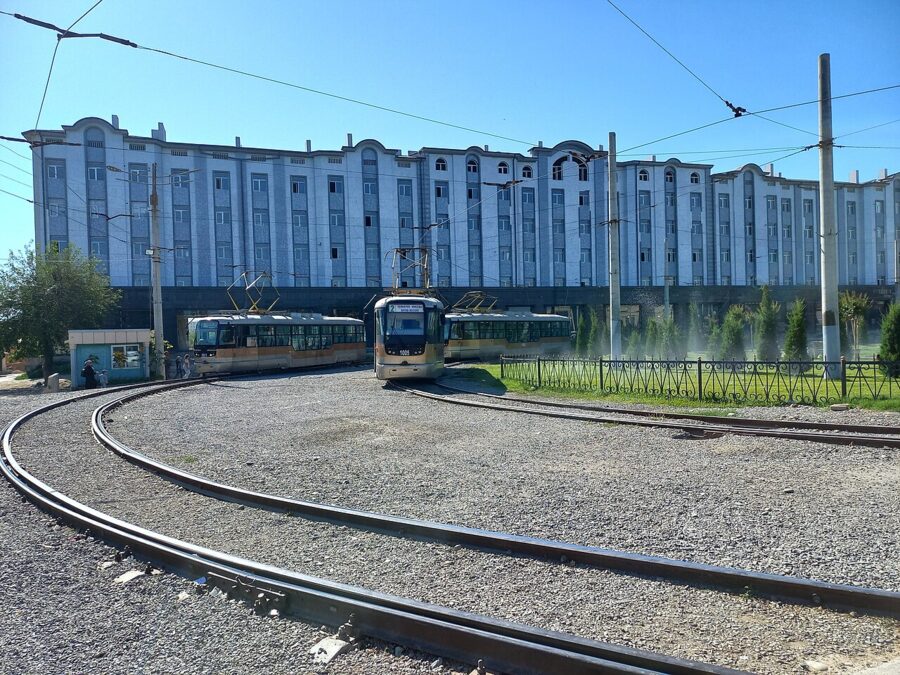
Day 5: Samarkand to Bukhara
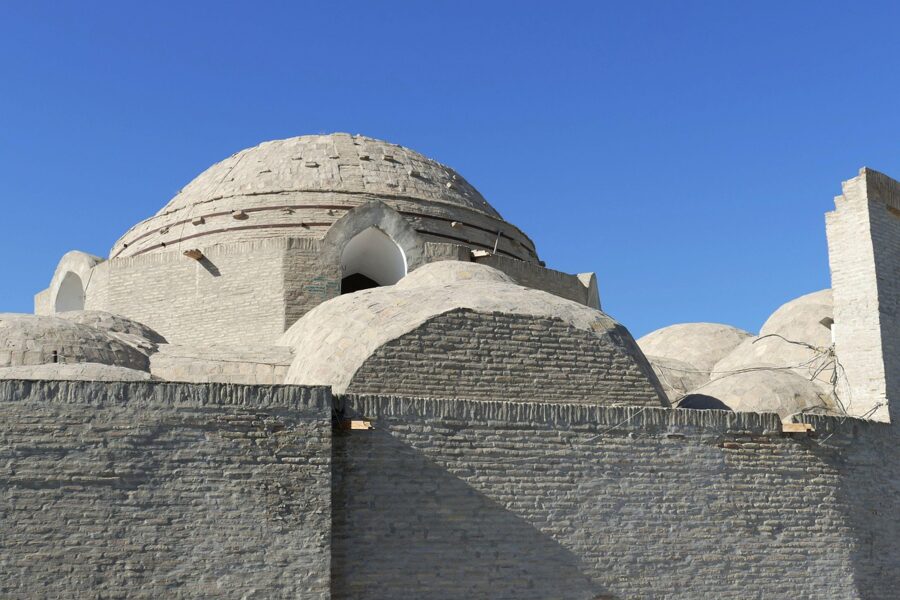
Catch the Afrosiyob 766 at 9:43 a.m. to reach Bukhara-1 at 11:39 a.m., or the 770 an hour later. If both are full, the 11:46 a.m. Sharq is a fine ride of about three hours. Spend two nights: Bukhara is a city for walking, and the old center around the Kalon Minaret and the trading domes is at its best early and late.
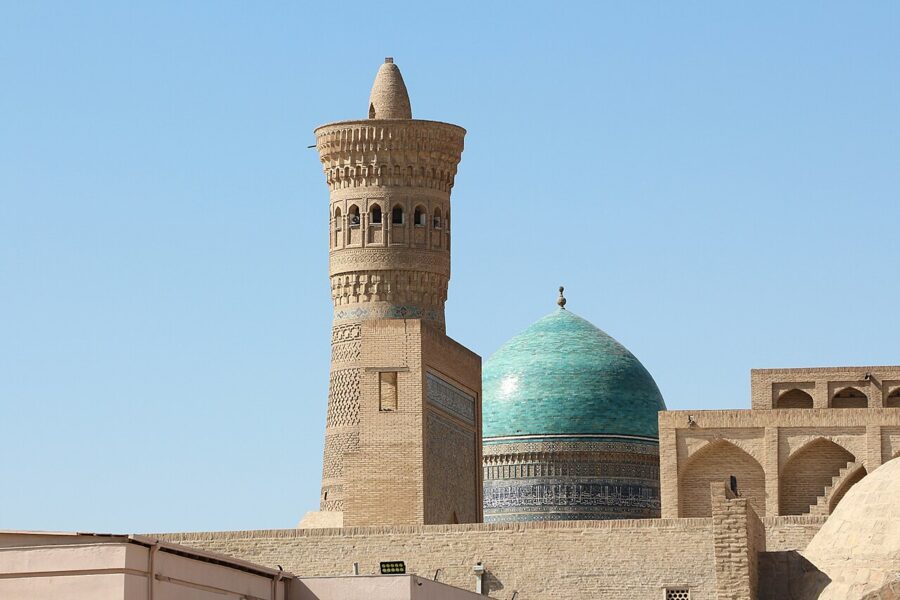
Day 7: the high-speed train to Khiva
This is the leg the new train made possible. Board the Jaloliddin Manguberdi at Bukhara-1 at 11:14 a.m. and you are in Khiva at 2:42 p.m., at 332,000 som (about US$28) in economy as of 2026. The line runs northwest across the Kyzylkum before the irrigated farmland of the Khorezm oasis closes in around Urgench.
Book this one first. With a single high-speed train a day on the Khiva line, it is the leg with the fewest alternatives, and if it is full the fallback is the morning sleeper from Bukhara, which reaches Khiva around noon after leaving before dawn.
Day 8 and home
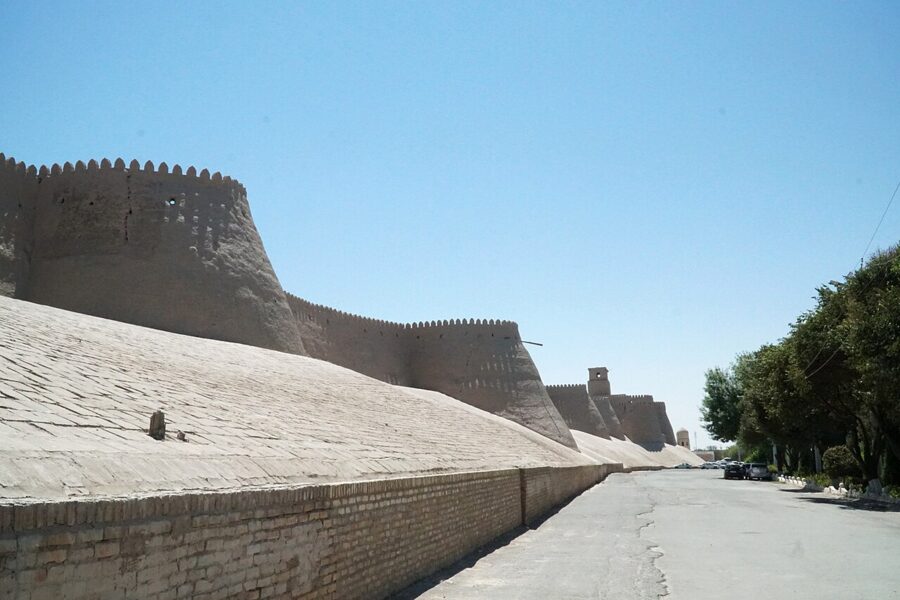
Give Khiva a full day; Itchan Kala is small enough to walk end to end, and the walls are best at sunset. To leave, take sleeper 056 at 6:00 p.m. back to Tashkent South for 8:22 a.m. (Wednesday, Thursday, Saturday and Sunday), or the 25,000-som local train to Urgench Airport for a flight out.
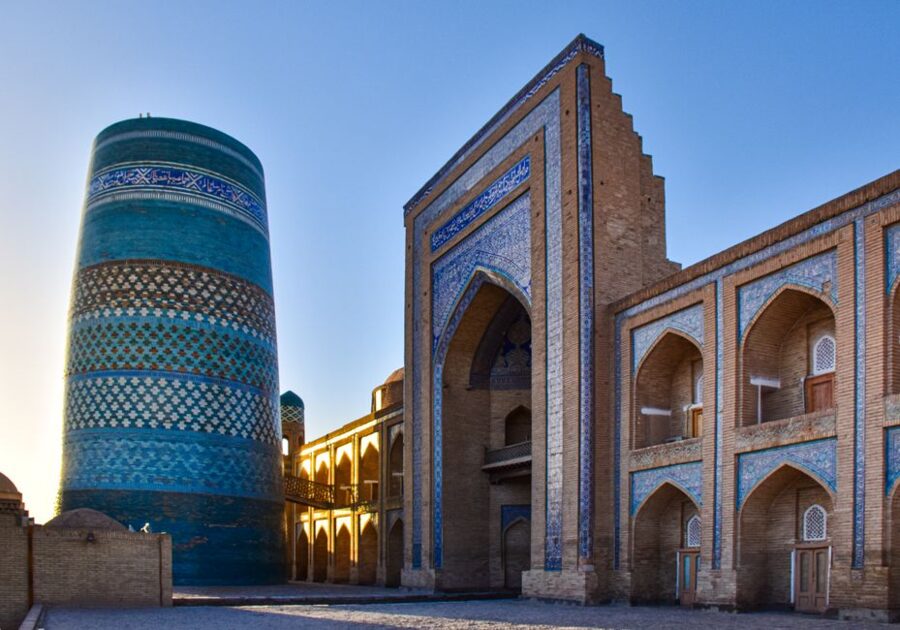
If you have only five days, cut Tashkent to an arrival night and give Khiva a single afternoon before the evening sleeper home, and you can still see Samarkand and Bukhara properly. If you have longer, the trains east into the Fergana Valley run from the same Tashkent North station, and the long-distance trains from Tashkent continue to Almaty in Kazakhstan, a journey on the scale of the Qinghai–Tibet Railway without the altitude.
Uzbekistan’s fast trains will not feel exotic if you have ridden China’s high-speed trains, and they are not trying to be. What they do is make the Silk Road cities a morning apart, for the price of a dinner. Book the 7:30 a.m. Afrosiyob out of Tashkent North the day it goes on sale, and save the Sharq for the morning it does not.