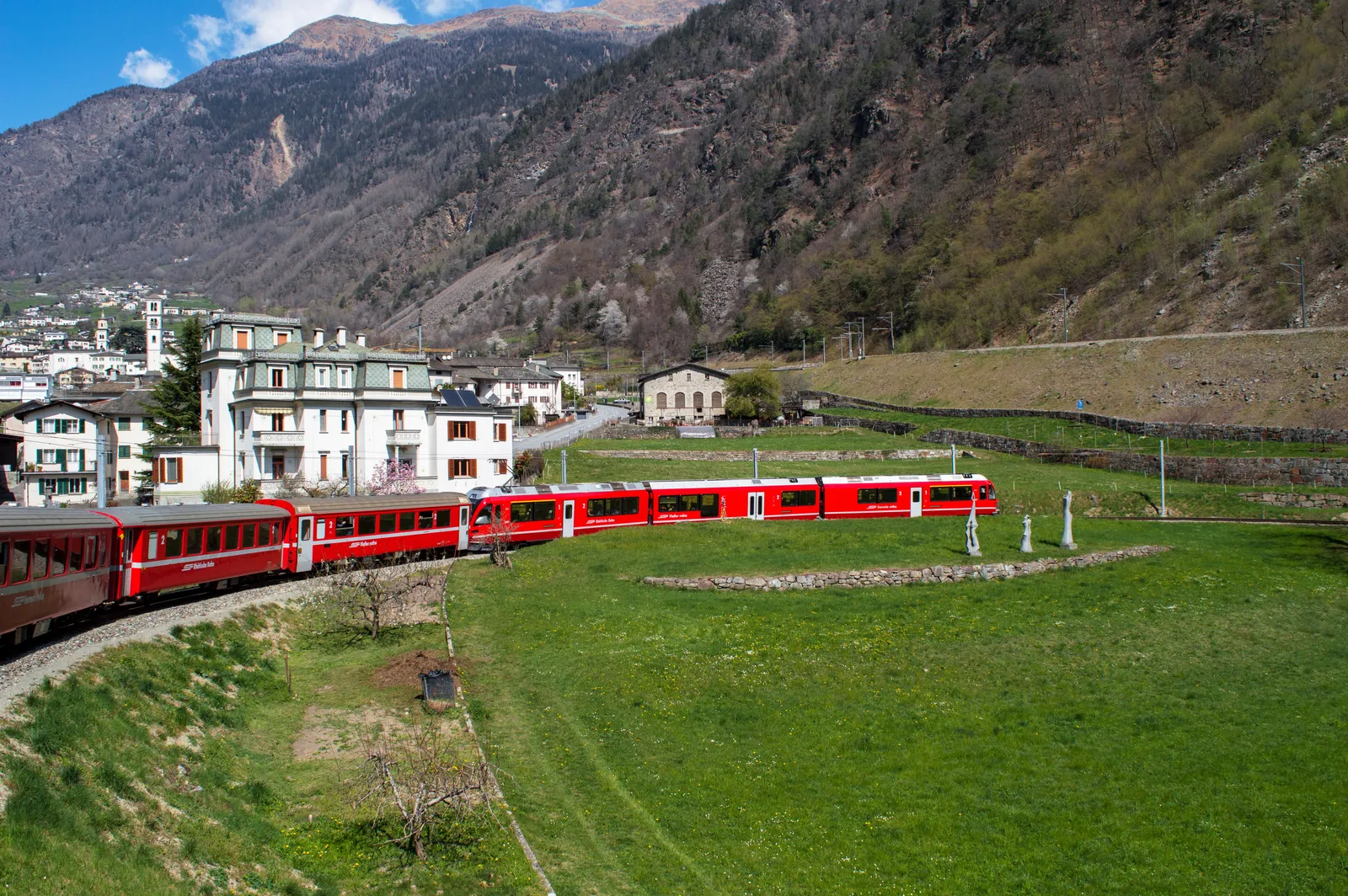
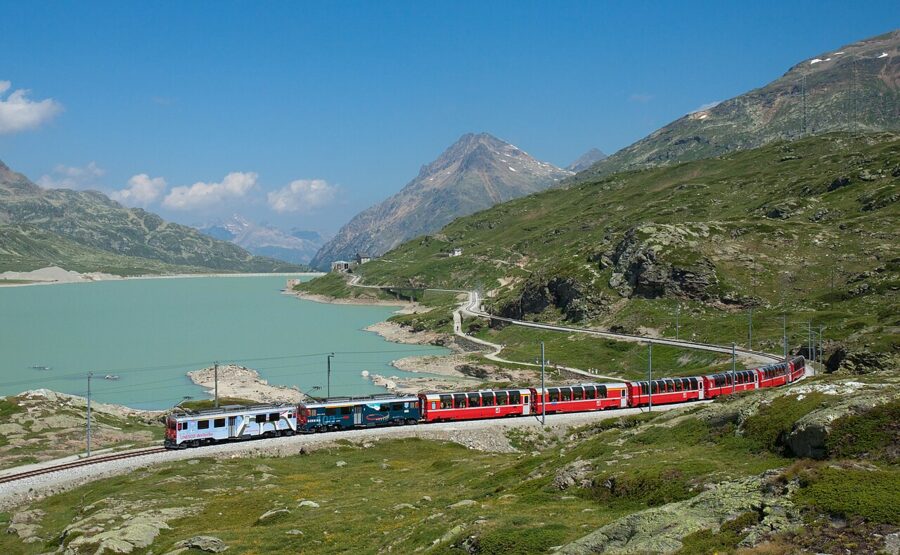
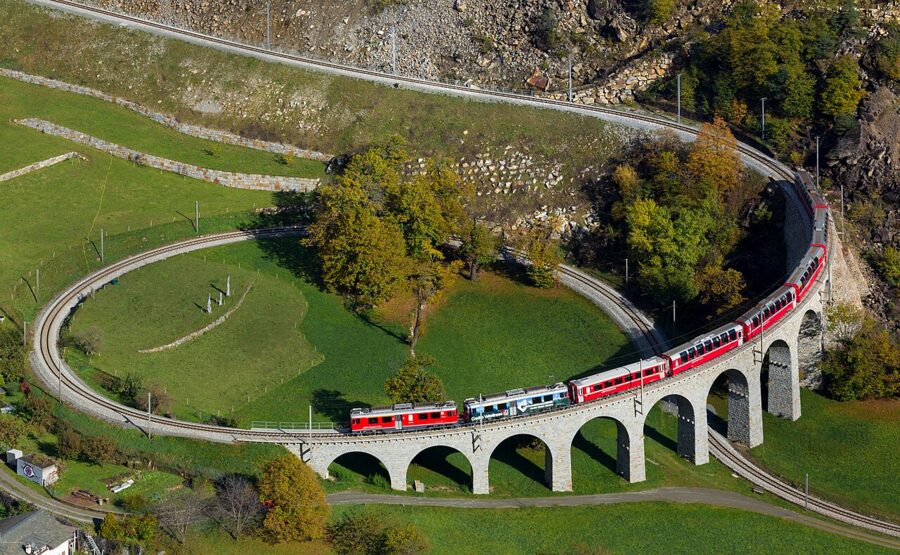
Southbound out of St. Moritz, the Bernina line climbs past the Morteratsch glacier to Ospizio Bernina, 2,253 meters up, where Lago Bianco lies right beside the track. Then it falls. In a little over two hours the same narrow-gauge rails drop past Alp Grüm, loop through the Brusio spiral viaduct and run through the streets of Tirano, in Italy, among the palm trees.
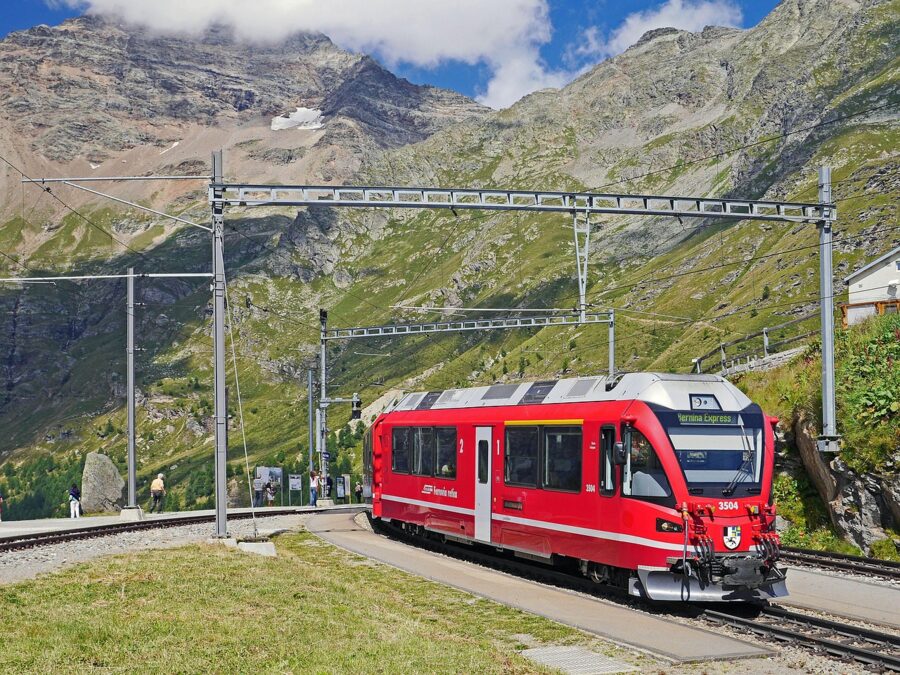
Two kinds of train make that trip. The Bernina Express has glass that curves into the roof, snacks served at your seat and a compulsory seat reservation of CHF 32 (about US$39) on top of the fare. The Rhaetian Railway’s ordinary regional trains run the same rails more often, with windows you can open and an optional CHF 5 seat reservation (about US$6). Same mountains, same viaducts, a very different bill.
That choice, the branded tourist train or the ordinary train with a view, runs through almost every great ride in Europe. Below are the Swiss classics and the best of the rest, which ones you book and which ones you just board, what they cost as of 2026, when they run, and how to string several into one trip.
Stops in this article6
- 01What makes a European train ride worth the trip
- 02Switzerland: the four panoramic trains, the pass and the supplements
- 03Norway, Scotland and the north
- 04The Alps beyond Switzerland, and the south
- 05Tourist train or ordinary train with a view: what to book
- 06Seasons, fares and putting a trip together (as of 2026)
What makes a European train ride worth the trip
America’s great scenic rides are mostly long-distance trains and heritage railroads. Europe’s are different in one useful way: the best mountain and coast lines are still part of the working network. Commuters, schoolchildren and skiers ride the same rails as the panoramic cars, so there is nearly always a cheaper train going the same way.
What makes a ride worth crossing an ocean for is engineering you can see from the seat. The Alpine lines climb over the mountains rather than under them, so they spiral, double back and cross gorges on stone viaducts. The best pack a change of climate into one morning, glacier at breakfast and vineyards at lunch.
The trick is knowing which trains are sold as an experience, with reservations and fixed departures, and which are ordinary services you can ride on a pass or a cheap ticket.
Switzerland: the four panoramic trains, the pass and the supplements
Switzerland sells four famous panoramic trains, each with its own rules. The Glacier and Bernina need a paid reservation for everyone, pass holders included; the Gotthard Panorama Express is first class only, with a supplement; the GoldenPass Express needs no reservation at all.
Glacier Express: Zermatt to St. Moritz
The Glacier Express runs between Zermatt, under the Matterhorn, and St. Moritz in the Engadine, over the Matterhorn Gotthard Bahn and the Rhaetian Railway. In the winter timetable (December 5, 2026 to May 7, 2027) train PE 902 leaves Zermatt at 8:50 a.m. and reaches St. Moritz at 4:36 p.m., close to eight hours in one seat.
A second departure, PE 920 at 7:50 a.m., runs only from December 12 to January 3 and from January 30 to May 7.
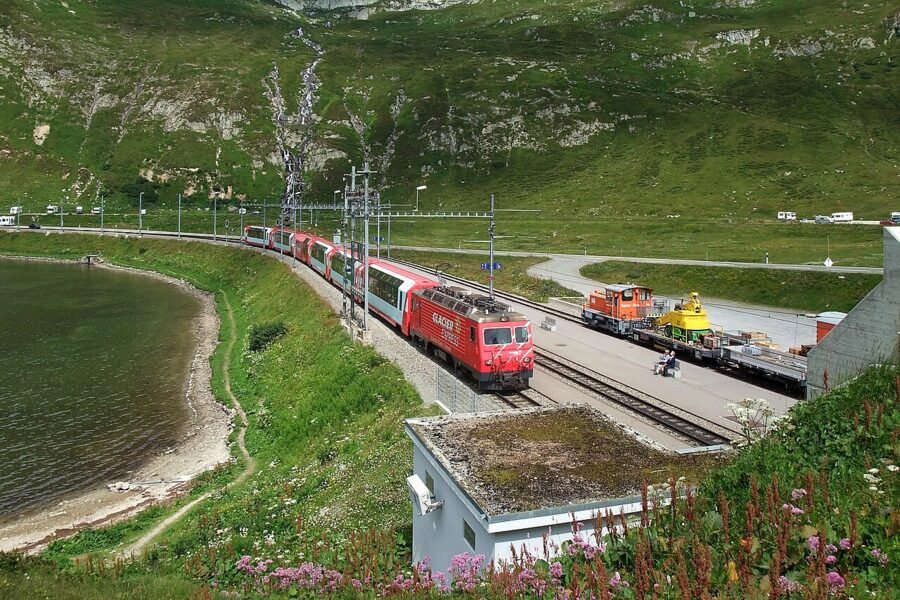
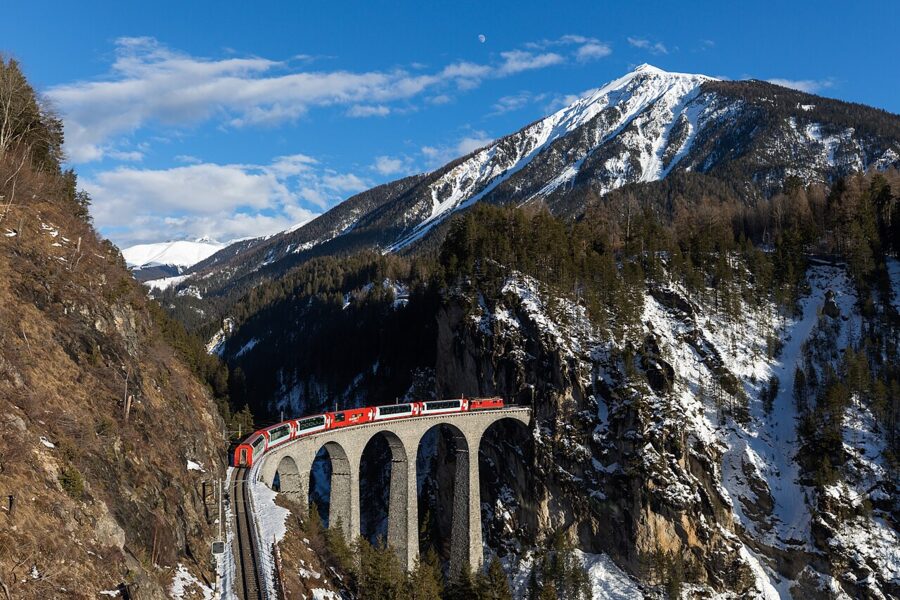
Going east, look left about ten minutes out of Zermatt for the Bis glacier above Randa. After Brig the train climbs to the Oberalp Pass, then drops past Disentis into the Rhine Gorge, white cliffs above a turquoise river. The last stretch is the Albula line and the Landwasser Viaduct, 65 meters high.
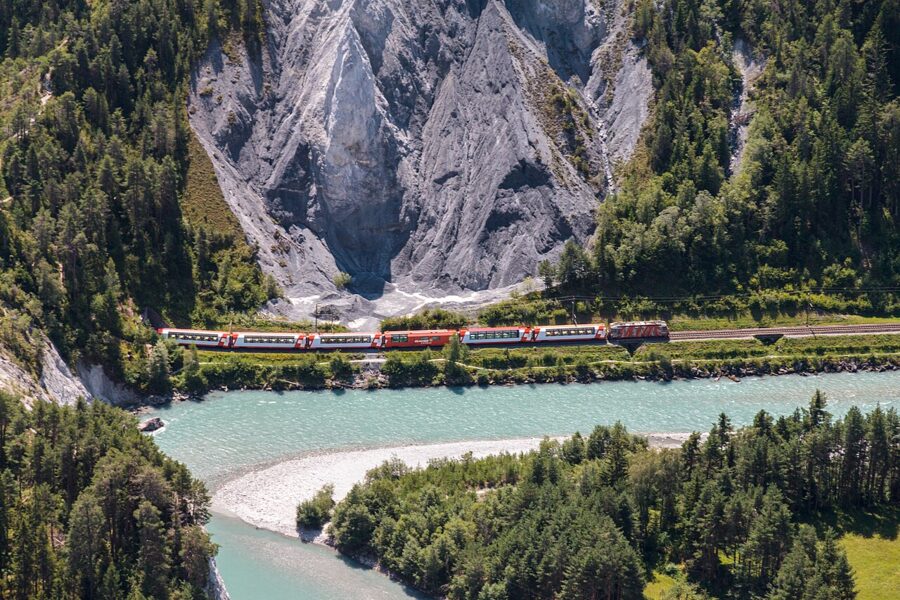
The Glacier Express fares for the whole route are CHF 166 in second class (about US$200) or CHF 284 in first, plus a compulsory CHF 54 seat reservation (about US$65) as of 2026. That makes CHF 220 (about US$265) for second class all in. The reservation costs the same however short the ride, so a hop like Brig to Zermatt (CHF 41 fare) is poor value on this train. Excellence Class adds a CHF 590 reservation, five-course menu included.
Tickets go on sale 180 days ahead and reservations 93 days ahead. The train carries no skis, golf bags, bicycles or oversized cases, and dogs are not allowed, so send big luggage ahead with a luggage service. Check the Glacier Express timetable for the summer times before you book connections.
Bernina Express: Chur or St. Moritz to Tirano
The Bernina Express runs from Chur or St. Moritz to Tirano, just over the Italian border. From Chur it takes about four hours over 196 bridges and through 55 tunnels; from St. Moritz, about 2 hours 15 minutes, covering the Bernina half only, which holds the glaciers and the long descent.
The Bernina Express fare from Chur to Tirano is CHF 69 in second class (about US$83) or CHF 118 in first, and from St. Moritz CHF 35 (about US$42) or CHF 60, as of 2026. The reservation is priced by train: CHF 32 on the St. Moritz trains all year, and on the Chur trains CHF 40 in low season (to April 23, 2027) or CHF 44 in peak season (April 24 to October 3, 2027).
Children under six ride free and ages six to 16 pay half the fare, but everyone pays the full reservation. Reservations open for the whole timetable year, and summer weekends sell out, so reserve as soon as your date is fixed. If you are flexible, RhB sells a last-minute deal from CHF 87, ticket and reservation together, online from six days before departure on selected second-class trains, with no refunds.
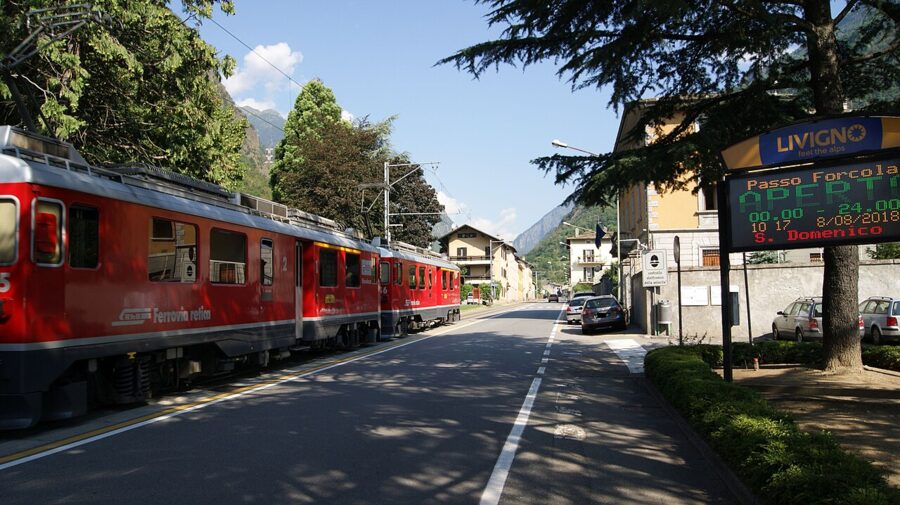
Two traps. The Bernina Express Bus from Tirano to Lugano is a coach, not a train: CHF 41 one way in second class plus its own reservation of CHF 16 or CHF 18 by season, running daily from March 25 to October 3, 2027. And a ticket sold as the “Bernina red train” or “Trenino Rosso” usually means the regional train, not the panoramic one.
GoldenPass Express: Montreux to Interlaken
For more than a century, Montreux to Interlaken meant changing trains at Zweisimmen, where the meter-gauge Montreux Oberland Bernois met the standard-gauge line to Spiez. The GoldenPass Express ends that with bogies that change gauge on the move, so a few trains a day now run straight through. Expect lakes and chalets rather than glaciers: the climb above Lake Geneva, Gstaad, then Lake Thun.
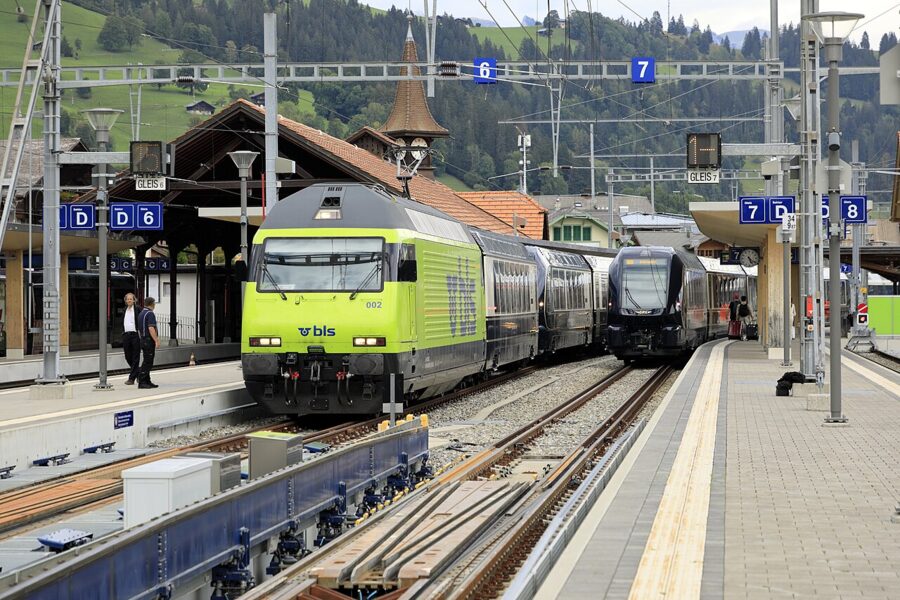
On the MOB fare table, Montreux to Interlaken Ost is CHF 112 in second class (about US$135) or CHF 192 in first. A seat reservation is optional on the GoldenPass Express and costs CHF 20 (about US$24) per journey whatever the distance. The Swiss Travel Pass covers the fare.
Gotthard Panorama Express: Lucerne to Lugano by boat and train
This one starts on the water. A lake boat leaves Lucerne at 11:12 a.m. and reaches Flüelen at 1:55 p.m., where a first-class panoramic train takes the old Gotthard mountain line at 2:09 p.m. and arrives in Lugano at 4:41 p.m.
Northbound, the train leaves Lugano at 9:20 a.m. and the boat reaches Lucerne at 2:47 p.m. In 2027 it runs daily from April 17 to October 17, and bookings open in January.
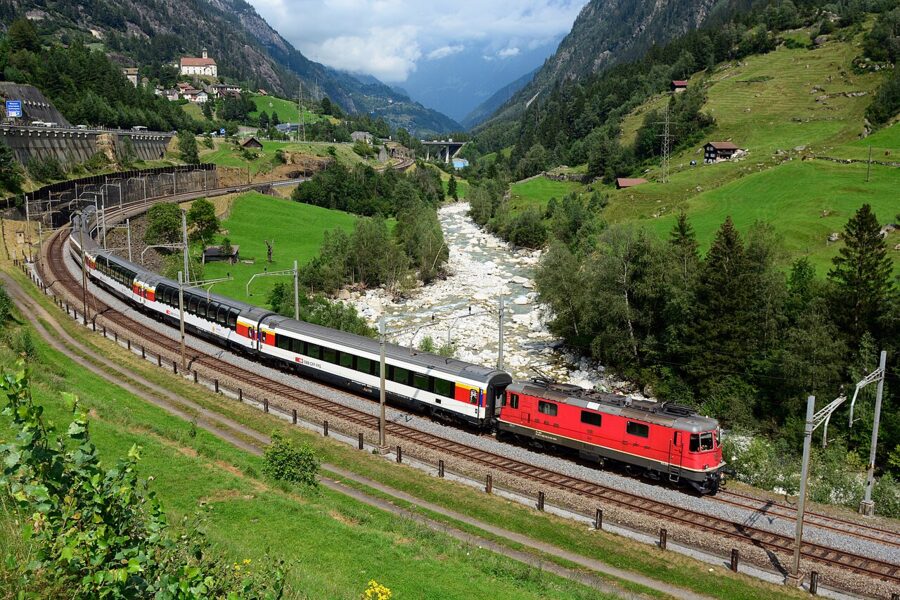
The Gotthard Panorama Express prices start from a first-class ticket, CHF 176 from Lucerne to Lugano (about US$212), plus a compulsory CHF 28 supplement (about US$34) that includes the seat. A first-class Swiss Travel Pass leaves only the CHF 28 to pay. A second-class pass needs a CHF 31.50 upgrade as well. Eurail and Interrail passes are not valid on the boat, though the lake company gives pass holders 50% off.
The Swiss Travel Pass and the supplements
The Swiss Travel Pass gives unlimited travel by train, bus and boat on 3, 4, 6, 8 or 15 consecutive days, including the premium panoramic trains, but reservations and supplements are extra. As of 2026 it costs CHF 254 for three days in second class (about US$306), CHF 309 for four days, CHF 399 for six, CHF 439 for eight and CHF 499 for fifteen. First class runs from CHF 405 for three days to CHF 778 for fifteen.
If you are under 25, the Youth version costs 30% less. Children aged 6 to 15 ride free with a parent who holds a pass, on the free Swiss Family Card. You can buy the pass up to 11 months ahead, and only if you live outside Switzerland and Liechtenstein.
| Train | Full fare (2nd class) | Reservation or supplement | With a Swiss Travel Pass |
|---|---|---|---|
| Glacier Express, Zermatt to St. Moritz | CHF 166 | CHF 54, compulsory | Pay CHF 54 |
| Bernina Express, Chur to Tirano | CHF 69 | CHF 40 low season, CHF 44 peak, compulsory | Pay CHF 40 or 44 |
| Bernina Express, St. Moritz to Tirano | CHF 35 | CHF 32, compulsory | Pay CHF 32 |
| GoldenPass Express, Montreux to Interlaken Ost | CHF 112 | CHF 20, optional | Free, CHF 20 if you reserve |
| Gotthard Panorama Express, Lucerne to Lugano | First class only: CHF 176 | CHF 28, compulsory | CHF 28 (1st-class pass) or CHF 59.50 (2nd-class pass, with upgrade) |
| Bernina regional trains, St. Moritz to Tirano | CHF 35 | CHF 5, optional | Free, CHF 5 if you reserve |
Fares as of 2026. Does the pass pay off? The full Glacier and Bernina fares alone come to CHF 235 in second class, so a three-day pass at CHF 254 roughly breaks even on those two rides and wins once you add a lake boat or the Rigi, which the pass includes.
Norway, Scotland and the north
The northern lines are ordinary public trains, running all year with no supplements, but the cheapest seats and the summer Flåm departures go early.
The Bergen Line: Oslo to Bergen
Vy runs six or seven trains a day over the Bergen Line, which opened in 1909 and is 471 km (293 miles) long. The trip takes about 6.5 to 7.5 hours depending on the train. Past Geilo the line climbs onto the Hardangervidda, northern Europe’s largest mountain plateau, through 182 tunnels and up to 1,237 meters, which makes it northern Europe’s highest railway line.
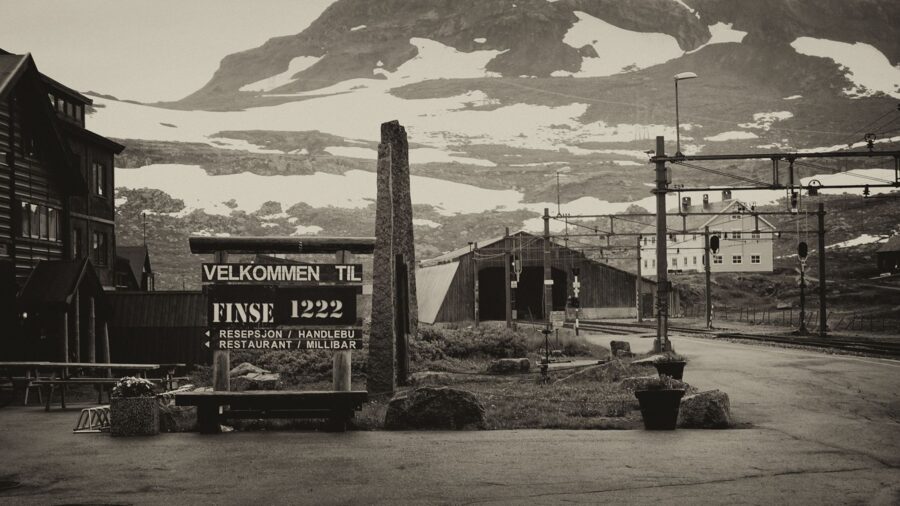
Myrdal is where you change for Flåm. Then the line tips down through the 5,311-meter Gravhals tunnel to Voss and Bergen. Take a day train: the night service has sleepers, but it crosses the plateau in the dark.
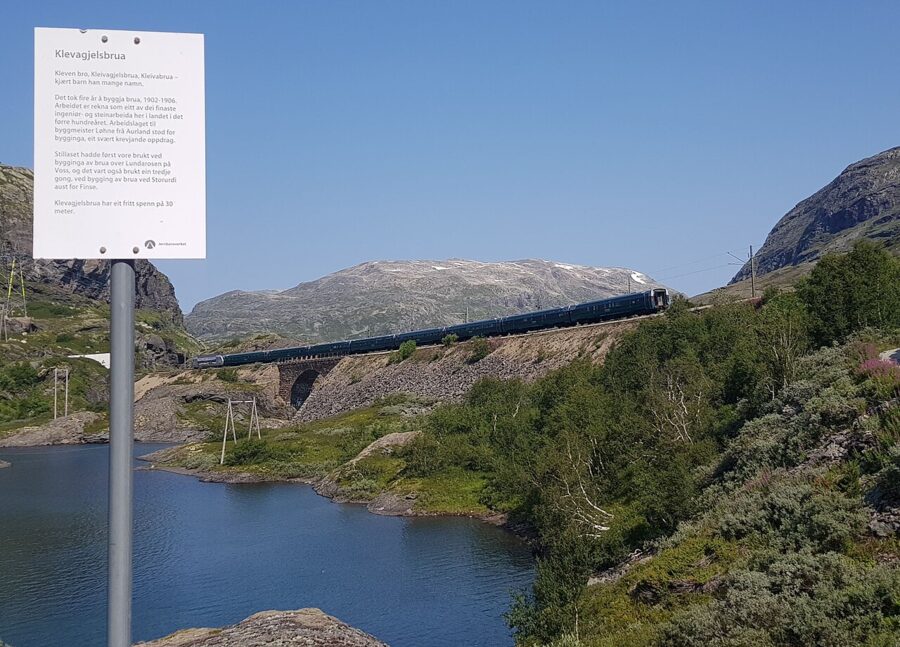
Vy sells several ticket types. Lowfare tickets are the cheapest, limited in number, and cannot be changed or refunded; on the Bergen Line you are given a seat before travel.
The Flåm Railway: Myrdal down to the fjord
The Flåm Railway drops 20 km from Myrdal, at 867 meters on the Bergen Line, to Flåm at the head of the Aurlandsfjord. It takes about an hour. Eighty percent of the line is at a 5.5% gradient, and 18 of its 20 tunnels were dug by hand; one turns 180 degrees inside the mountain. It opened on August 1, 1940.
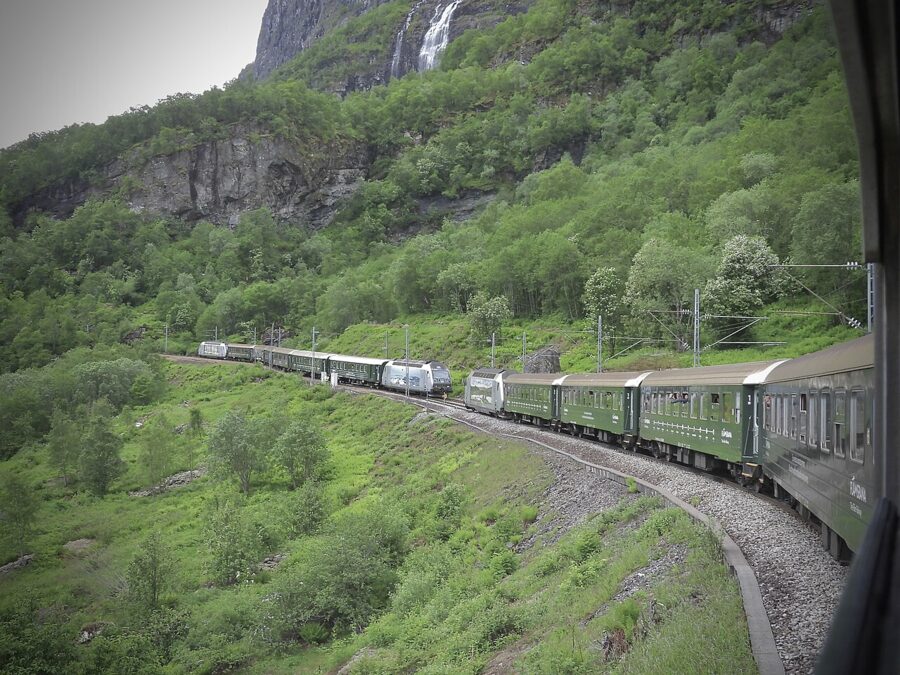
It runs all year. In the winter timetable (to March 31, 2027) four round trips leave Flåm, at 9:00 a.m., 11:45 a.m., 2:30 p.m. and 4:50 p.m.
Flåm Railway round-trip tickets go on sale 120 days ahead, and when a departure sells out, there are no extra seats to be had. Fares change by season, so check the booking calendar.
Riding through from Oslo or Bergen, buy the Flåm leg with your Bergen Line ticket from Vy. Eurail and Interrail holders get 30% off single tickets, not free travel.
The West Highland Line: Glasgow to Fort William and Mallaig
ScotRail’s West Highland Line leaves Glasgow Queen Street, follows Loch Lomond, and splits at Crianlarich for Oban or for Fort William and Mallaig. The Fort William branch is the one to ride. It crosses the bogs and lochans of Rannoch Moor, calls at remote Corrour with no public road to it, then runs past Fort William to the Glenfinnan Viaduct and the sea.
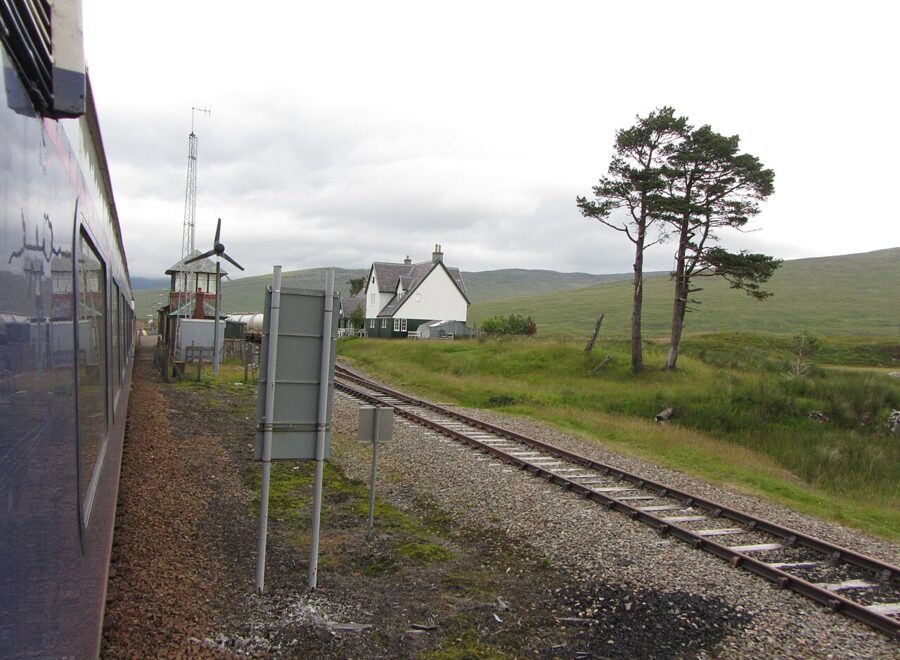
The extension from Fort William to Mallaig opened on April 1, 1901, and its builder, Robert McAlpine, used mass concrete where stone failed. His Glenfinnan Viaduct has 21 arches standing about 100 feet above the River Finnan. On the ordinary train you cross it the same as on the steam train, for an everyday fare. Check ScotRail’s journey planner for current fares and times.
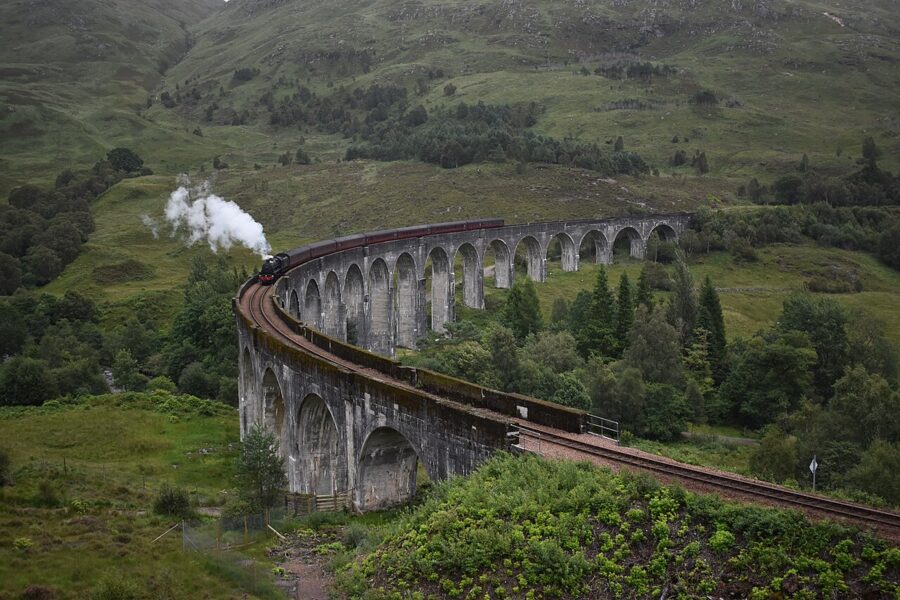
The Jacobite steam train
West Coast Railways runs the Jacobite from Fort William to Mallaig and back, 84 miles behind a steam locomotive, often the Black Five No. 45407. It pauses at Glenfinnan when the timetable allows, and you get about an hour and a half in Mallaig before the return.
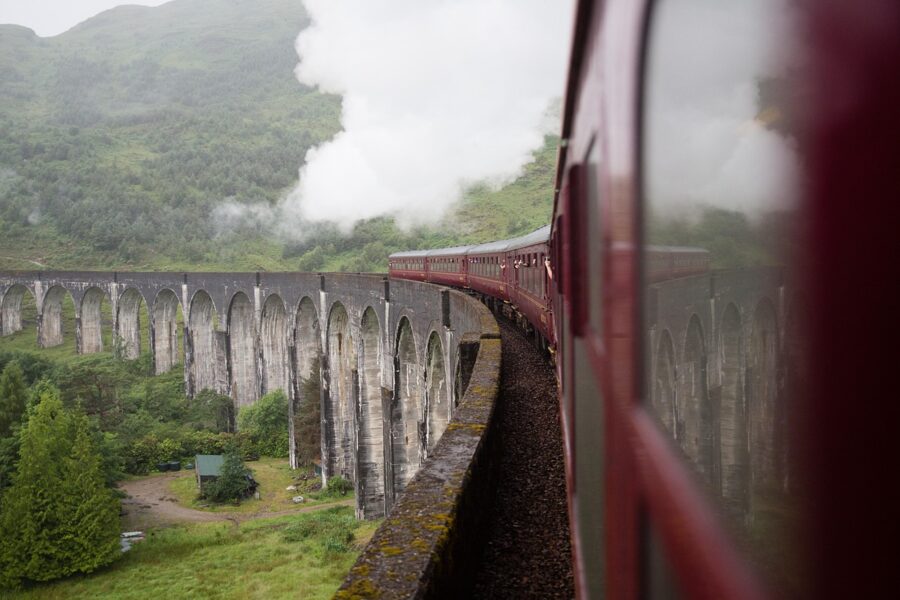
As of late November 2026, dates and fares for the 2027 season are not yet published; the operator asks you to register for launch news. On the day, the guard may sell a few seats at Fort William, cash only and never guaranteed. When fire risk is high, a diesel may haul it instead of steam.
Is it worth it? For the steam, the sound and the smell on a Highland gradient, yes, once. For the view alone, the ScotRail train over the same viaduct does the job for less and runs all year.
The Alps beyond Switzerland, and the south
South and east of Switzerland the great rides get cheaper and less organized, and most need no reservation at all.
The Semmering Railway, Austria
The Semmering Railway between Gloggnitz and Mürzzuschlag is the oldest mountain railway in the world, almost 170 years in service and a UNESCO World Heritage site. It is not a tourist train. About 180 trains a day use it, including ÖBB’s trains between Vienna and Graz, so an ordinary ticket and a window seat are all you need.
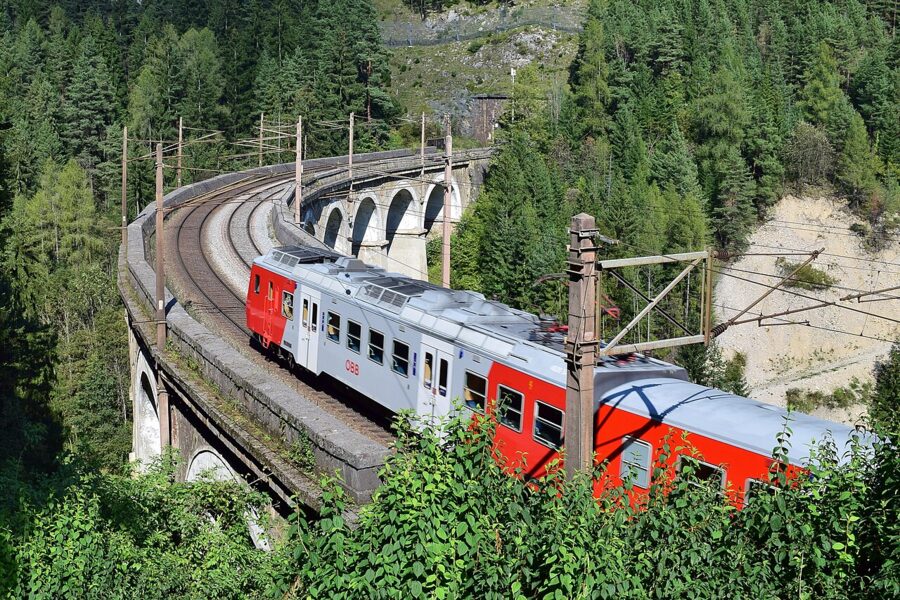
Ride it before the fast trains go underground. ÖBB says long-distance trains will switch to the new 27 km Semmering Base Tunnel from 2030, leaving the old line to regional services.
The Centovalli line: Locarno to Domodossola
The narrow-gauge Centovalli line, run jointly by Swiss and Italian operators, links Locarno on Lake Maggiore with Domodossola in Italy through the “hundred valleys” and the Val Vigezzo. Expect high bridges over gorges, chestnut woods and stone villages, on small panoramic and regional trains. It also closes a loop: Lucerne to Locarno over the Gotthard, the Centovalli to Domodossola, then the Simplon line back to Brig.
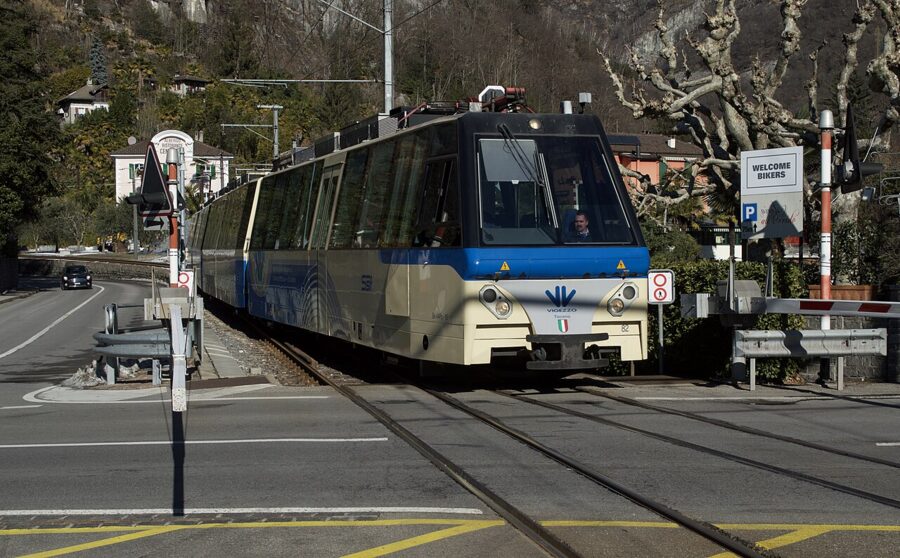
Check current fares, and whether your pass covers the Italian half, at the ticket office in Locarno.
The Cinque Terre line, Italy
Trenitalia’s regional trains between Levanto and La Spezia call at all five villages: Monterosso, Vernazza, Corniglia, Manarola and Riomaggiore. Be clear about what this is. It is a commuter shuttle that spends most of its time in tunnels, with the sea in flashes between them, and its real job is getting you from village to village.
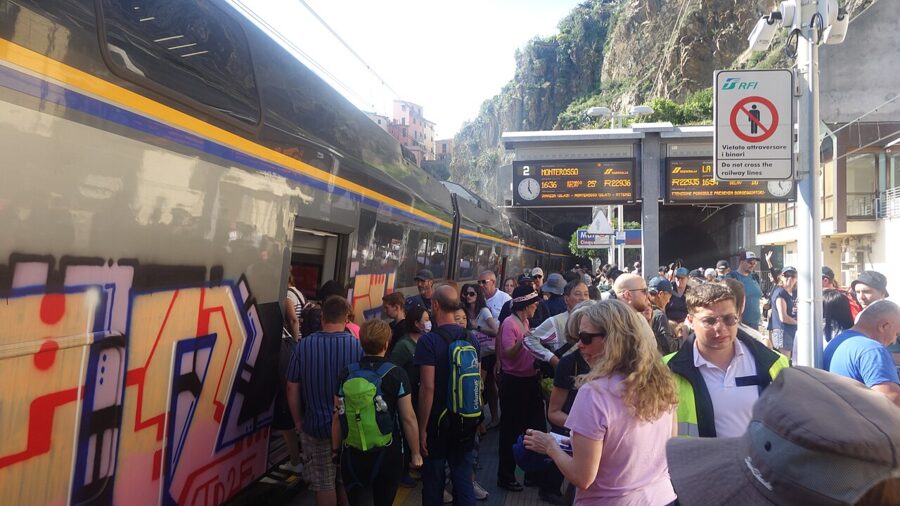
From November 2, 2026 to March 19, 2027, the Cinque Terre trains take ordinary Liguria regional tickets, which you must stamp before boarding. Alternatively, the Cinque Terre Treno MS Card gives unlimited second-class rides between Levanto and La Spezia plus the park’s services: €17.30 a day (about US$19), €29 for two days and €34 for three, for travel to December 31, 2026. Summer fares are set separately each season, so check them in spring.
Spain’s narrow-gauge north
Along Spain’s green northern coast runs a meter-gauge network, the old FEVE lines now operated by Renfe, linking Bilbao, Santander, Oviedo and Ferrol. Most of it is slow local service, sold under Renfe’s Cercanías for Bilbao, Cantabria, Asturias and Ferrol. On the same rails Renfe runs its tourist trains: the Expreso de La Robla, the six-day Costa Verde Express between Bilbao and Santiago de Compostela, and the Transcantábrico Gran Lujo between San Sebastián and Santiago.
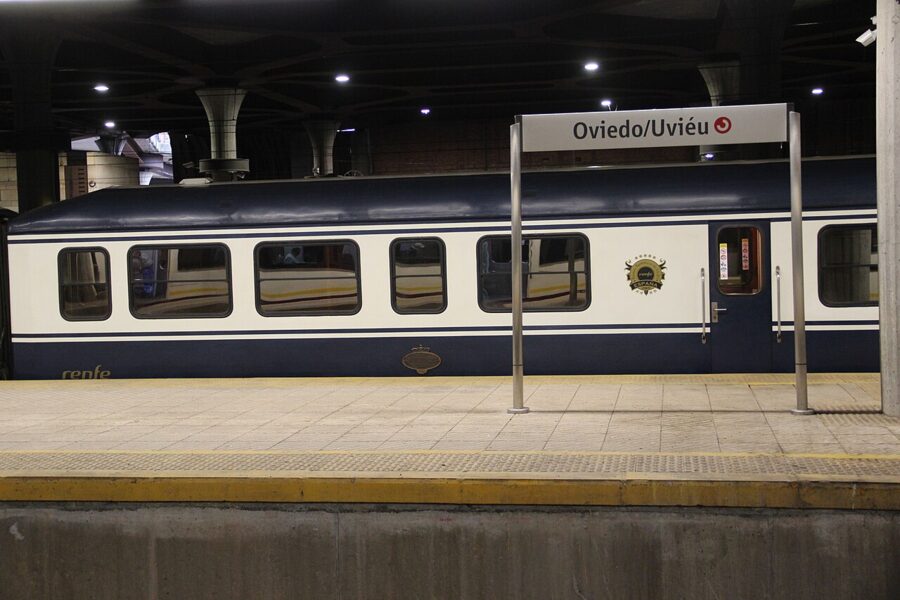
For an independent trip, ride the local trains in short legs between the cities on Renfe’s northern rail routes, and check the luxury trains’ 2027 dates and prices directly with Renfe.
The Douro line, Portugal
Comboios de Portugal (CP) runs the Douro line from Porto east along the river into port-wine country, through Régua and Pinhão to Pocinho, more than 170 km from Porto. The river views start well before Régua and get better beyond it, with terraced vineyards right down to the water. For most of the river stretch the river is on the right heading east.
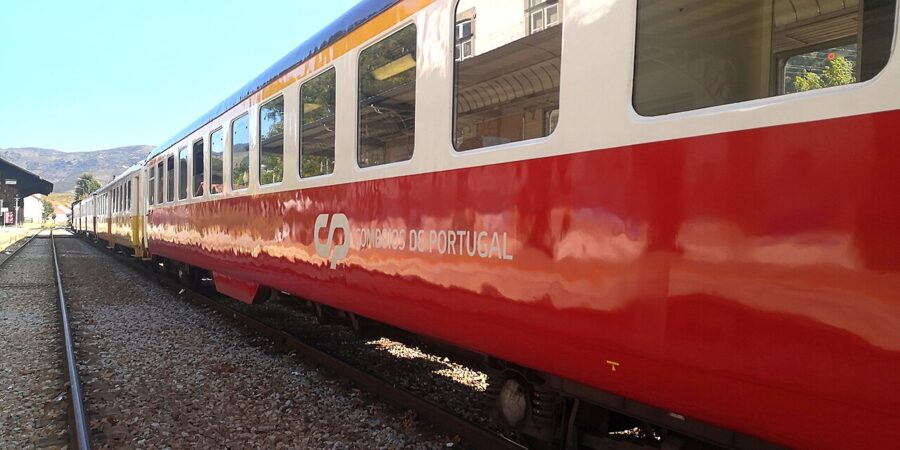
CP’s MiraDouro train uses Swiss-built Schindler carriages from the late 1940s, with windows that open, and runs daily from Porto São Bento. One-way fares from São Bento are €10.85 to Régua (about US$12), €12.95 to Tua and €14.80 to Pocinho, as of 2026. The summer Douro Historical Train, which ran from Régua to Tua between June and October, has closed for 2026, and CP has not yet announced the next season.
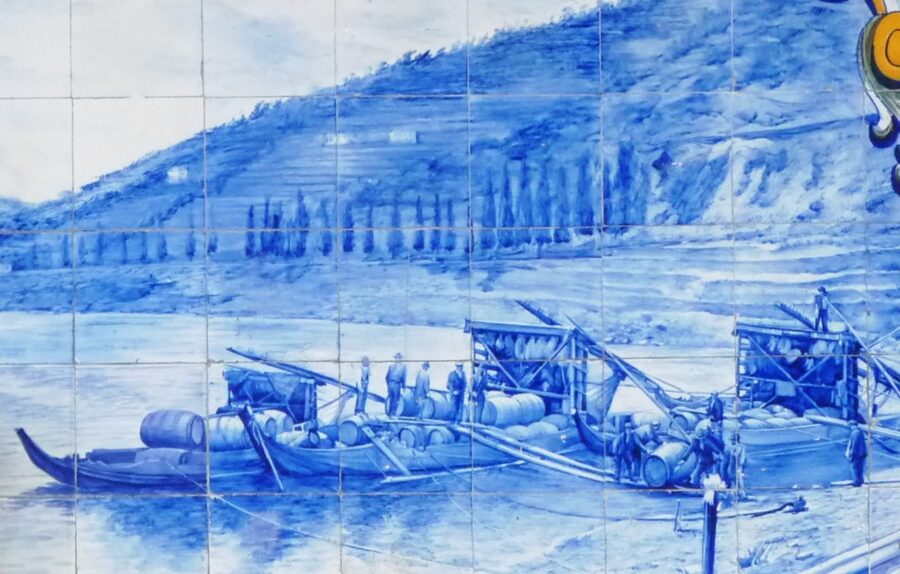
One big warning for winter. From November 3, 2026 to March 24, 2027, replacement buses run between Marco de Canaveses and Régua while the line is modernized, so the scenic stretch beyond Régua still runs by train but the approach does not. CP sells tickets online up to 60 days ahead.
The Harz and the Brocken steam railway, Germany
The Harzer Schmalspurbahnen run narrow-gauge steam trains up the Brocken, at 1,141 meters the highest summit in northern Germany. The Brocken fare is the same from any station on the network: €43 one way (about US$47) or €65 round trip as of 2026. An afternoon return on selected trains costs €55.
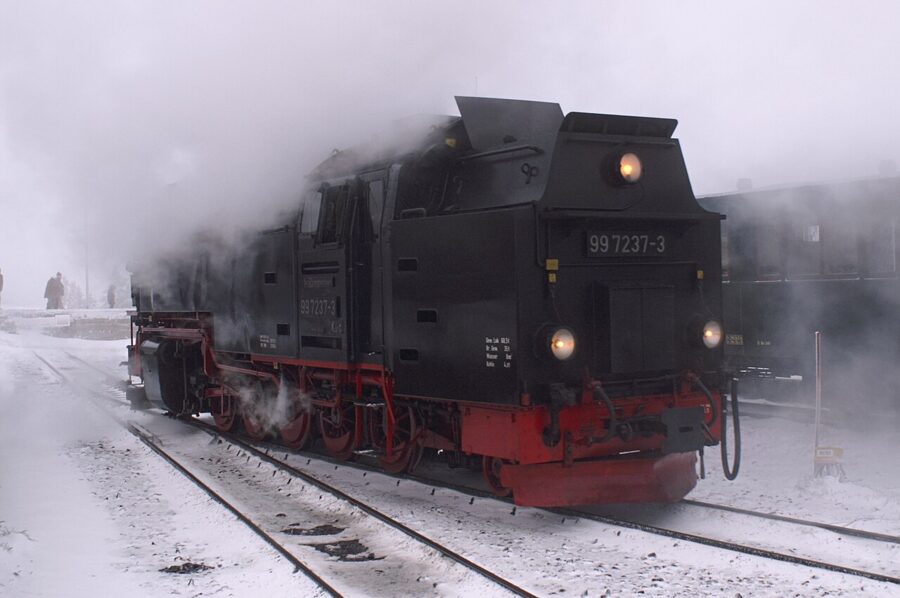
Seat reservations are only for groups of eight or more, so individuals just board; arrive early on summer weekends. Make it a day out from Wernigerode rather than a journey, and walk down part of the way if the weather holds.
Belgrade to Bar: Serbia to the Montenegrin coast
The Belgrade to Bar line runs from the Serbian capital through the Dinaric mountains to the Adriatic, over the Mala Rijeka viaduct near Podgorica. It is one of the most dramatic long rides in Europe, and the cheapest. Montenegro’s railway, ŽPCG, sells second class from Bar to Belgrade for €23.80 (about US$26), plus a compulsory €3 seat reservation, as of 2026.
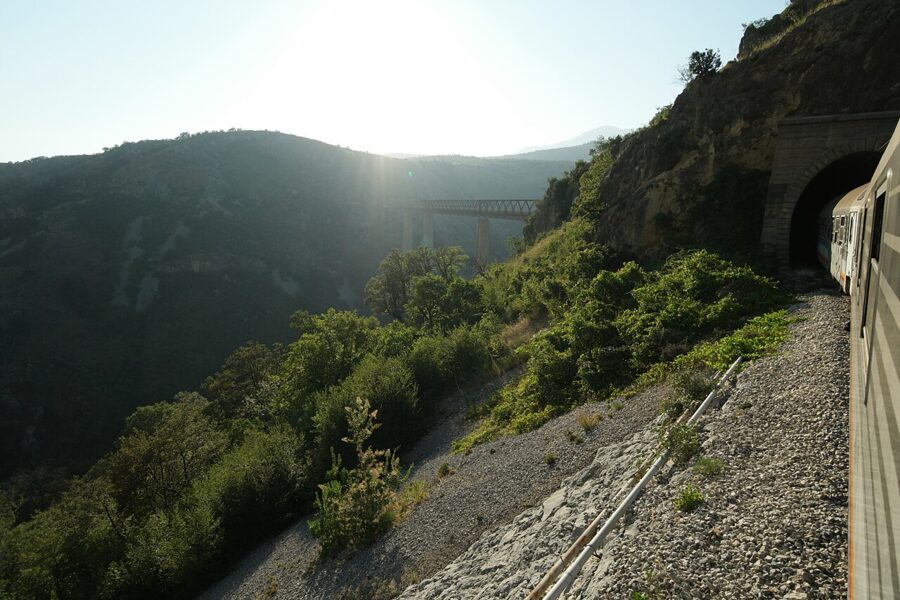
The catch is timing. The all-year service is a night train.
ŽPCG’s timetable shows train 432 leaving Bar at 8:10 p.m. and reaching Belgrade at 7:08 a.m., so the mountains pass in the dark.
In summer 2026 a seasonal day train ran from June 12 to September 14, changing at Bijelo Polje, Bar at 9 a.m. to Belgrade at 8:17 p.m. Watch for the 2027 announcement; that is the train to take.
Tourist train or ordinary train with a view: what to book
On almost every line above, an ordinary train runs on the same rails as the famous one. Here is how I would choose.
| Line | The tourist train | The ordinary train | My pick |
|---|---|---|---|
| Bernina line | Bernina Express, CHF 32 to 44 reservation, panoramic glass | RhB regional, CHF 5 optional seat, opening windows, more departures | Regional for photos and stops; Express once, southbound |
| Glacier route | Glacier Express, CHF 54 reservation, meals at your seat | MGB and RhB regional trains in stages | Regional with a night in Andermatt, unless eight hours in one seat sounds like a treat |
| Montreux to Interlaken | GoldenPass Express, optional CHF 20 seat | MOB and BLS trains with a change at Zweisimmen | The Express; the through ride is the point |
| Gotthard mountain line | Gotthard Panorama Express, 1st class plus CHF 28 | Regional trains over the old line, and an ordinary lake boat | The Panorama Express on a clear day; regional if the forecast is gray |
| Fort William to Mallaig | The Jacobite, steam, seasonal | ScotRail, all year | ScotRail for the view, the Jacobite for the steam |
| Douro | Douro Historical Train, summer only | CP regional and MiraDouro, daily | MiraDouro, windows open |
The panoramic cars have one weakness: their glass does not open, and on a sunny day it reflects the carriage back at your camera. RhB’s regional coaches have windows that open, so if photographs matter, ride the ordinary train.
Seasons, fares and putting a trip together (as of 2026)
When to go
Summer has everything running, including the Gotthard Panorama Express (April 17 to October 17, 2027), the Bernina Express Bus and the Jacobite, plus long northern days. It also has the sell-outs and the Cinque Terre crowds. June and September are my favorite months: nearly everything open, fewer people.
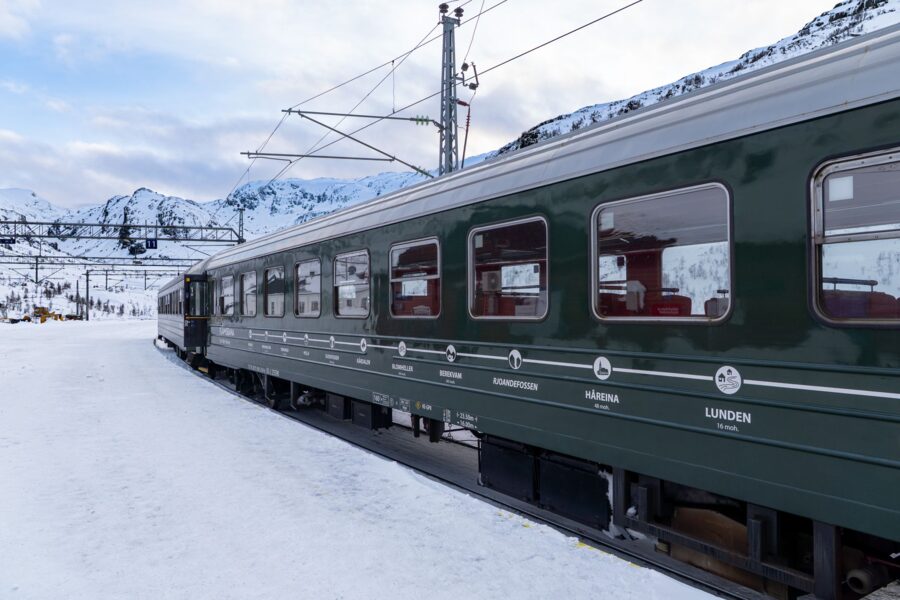
Winter has its own reward: snow on the Bernina, the Glacier and the Bergen lines, seen from a heated car. The Glacier Express winter timetable starts December 5, 2026. Watch for works: Douro buses to March 24, 2027, and Rhine Gorge buses on the Glacier route from April 17 to May 2. December is also the month of Christmas trains, a different kind of ride altogether.
Booking windows and what sells out
| Train | When booking opens | Book ahead? |
|---|---|---|
| Glacier Express | Tickets 180 days, seats 93 days ahead | Yes, in summer and at Christmas |
| Bernina Express | Seats for the whole timetable year; next year’s trains from mid to late October | Yes, especially summer weekends |
| Gotthard Panorama Express | From January for the 2027 season | Yes, for summer weekends |
| Flåm Railway round trips | 120 days ahead | Yes, June to August |
| Jacobite | 2027 not yet open; register with the operator | Yes, as soon as it opens |
| Douro line (CP) | Online up to 60 days ahead | Not usually |
| Swiss Travel Pass | Up to 11 months ahead | Buy once your dates are fixed |
| Semmering, Cinque Terre, Brocken, regional Bernina trains | Ordinary tickets | No, just board |
Chaining them into one trip
Switzerland strings together best, because the four panoramic trains nearly join up. Here is a four-day loop that works between May and early October:
- Day 1: Glacier Express, Zermatt to St. Moritz. Sleep in St. Moritz.
- Day 2: a morning Bernina Express, St. Moritz to Tirano, then the Bernina Express Bus at 2:20 p.m. along Lake Como to Lugano, arriving 5:30 p.m.
- Day 3: Gotthard Panorama Express, Lugano at 9:20 a.m., then the boat from Flüelen into Lucerne at 2:47 p.m.
- Day 4: Lucerne to Interlaken, then the GoldenPass Express to Montreux.
On a four-day second-class Swiss Travel Pass (CHF 309), the add-ons are the Glacier reservation (CHF 54), the Bernina reservation (CHF 32), the peak-season bus reservation (CHF 18), and the Gotthard supplement and upgrade (CHF 28 plus CHF 31.50). That comes to CHF 472.50 per adult (about US$569) as of 2026, before an optional CHF 20 GoldenPass seat and before hotels. Full fares for the same rides cost far more.
In Norway, ride the Bergen Line to Myrdal, take the Flåm Railway down, and sleep in Flåm. The next morning, ride back up to Myrdal and on to Bergen, booking every leg through Vy so the connections sit on one ticket.
In Scotland, take the ScotRail train from Glasgow to Fort William, sleep there, and ride the Jacobite (or the ScotRail train) to Mallaig the next day. In Portugal, after March 24, 2027, Porto to Pocinho and back on the MiraDouro is a long but easy day; Pinhão is the better turnaround if the days are short.
Back on the Bernina, then, here is how I would do it. Book the Bernina Express once, southbound from St. Moritz on a clear morning, for the glass roof over the glaciers. Then come back north on a regional train, window down, and get off at Alp Grüm for an hour.